
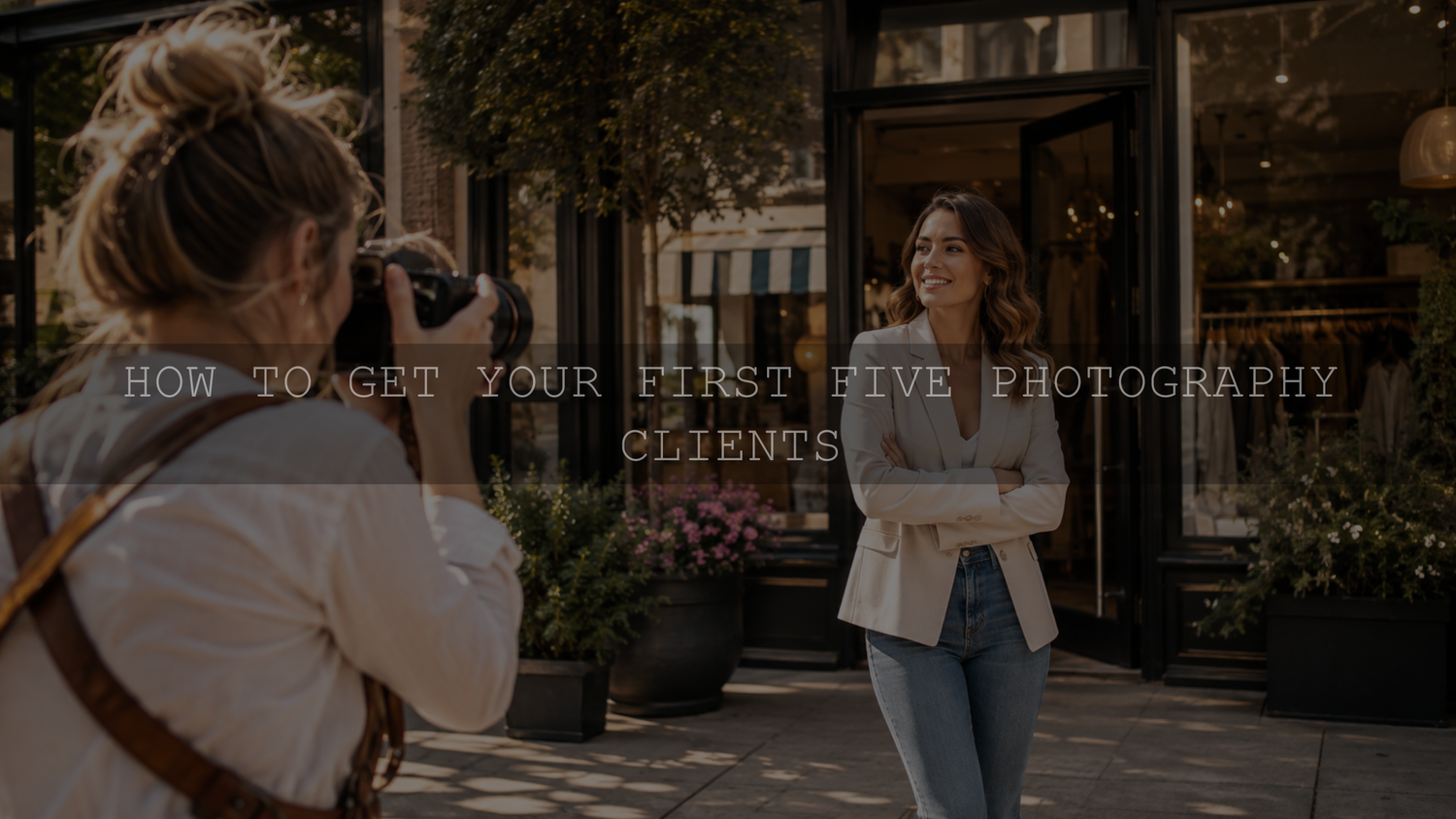
Getting your first five paid photography clients is usually less about having thousands of followers and more about giving the right people enough reason to trust a specific offer. Start with one photography service, create relevant portfolio proof, show that work to people who may genuinely need it, make the booking process clear and use each completed assignment to create stronger proof for the next one.
The goal of this guide is specifically your first five paid clients. Portfolio collaborations, model calls and practice sessions can help you reach that point, but they are not paying clients and should not be counted as evidence that the market will buy your service.
If you still need to build the wider business foundation around your portfolio, pricing, workflow and client process, begin with the AAAPresets guide to starting a photography business with no clients. This guide assumes that basic foundation is in place and focuses on turning it into paid-client acquisition.
1. Create One Photography Offer People Can Understand
Do not begin by marketing yourself simply as a photographer who can shoot anything. Your first clients need to understand quickly what they can hire you to do.
A useful starter offer should answer six questions:
- What type of photography are you selling?
- Who is the service intended for?
- Where do you provide it?
- What does the client receive?
- What does it cost or how is it quoted?
- What should the interested person do next?
For example, a portrait photographer might offer a short outdoor personal-brand session for local freelancers that includes a clearly defined session length, an edited-image range, online delivery and a stated booking process. A product photographer might instead offer a small starter package for local ecommerce brands covering a defined number of products and final images.
The offer does not have to become your permanent business model. Its purpose is to make the first purchasing decision straightforward. If you are unsure which service has realistic demand in your area, first research local photography demand instead of assuming that the niche with the most attractive photographs will automatically produce bookings.
2. Build Enough Portfolio Proof to Support the Offer
A prospective client should be able to see examples that resemble the work you are asking them to buy. An impressive landscape photograph does little to prove that you can direct a personal-brand portrait session, photograph a restaurant menu or deliver consistent product images.
If your portfolio is empty, create a limited number of intentional portfolio sessions before increasing your outreach. Photograph the subject, lighting conditions and type of finished work that your target client is likely to need.
Model calls and trade-for-portfolio collaborations can be useful here, but define them properly. Put the scope, deliverables, delivery date and intended image usage in writing. Obtain appropriate permission before publishing recognizable people, private locations or client-owned material, and adapt your agreement to the laws and requirements that apply where you operate.
Do not offer a free session in exchange for a positive or “glowing” review. If you request public feedback, ask for an honest review and follow the rules of the platform where the review will appear. A portfolio collaboration should create portfolio evidence, not manufactured social proof.
Before accepting paid work, make sure you can reliably complete the entire service rather than producing only one strong photograph. The guide to starting a photography business without professional experience provides a more detailed readiness check.
3. Start With Warm Contacts, but Make a Real Offer
Your existing network can shorten the distance between being unknown and being trusted, but avoid turning the process into a mass message asking everyone you know to support your new hobby.
Instead, identify people in your network who genuinely match the service or know people who do. Tell them clearly what you now offer, where you work and how someone can view the relevant portfolio.
A useful message has four parts: what you photograph, who the service is for, a link to representative work and one simple next step. If you have a genuine introductory package available, explain it directly rather than asking people to message you without knowing what you sell.
Your first paid booking may come from an acquaintance, former coworker, local business contact or someone introduced by a friend. What matters is that the assignment is treated like real client work with clear scope, payment, expectations and delivery.
4. Look for Existing Local Demand Instead of Posting Everywhere
Community marketing works best when you participate where people already discuss the service you provide. Depending on your market, this may include local Facebook groups, neighborhood platforms, community forums, business groups, wedding communities, parent groups, university communities or regional online forums.
Follow each community's promotional rules. Do not paste the same sales message into unrelated discussions. When someone genuinely requests a photographer, respond with information that matches the request and send them to the most relevant part of your portfolio.
For example, someone looking for graduation portraits should not have to search through wedding, food, travel and property photographs before finding the work that answers their question.
If your photography business meets Google's face-to-face eligibility requirements, a Google Business Profile lets you manage how the business appears in Google Search and Maps. Photographers who travel to clients and do not serve customers at their business address should remove the public address and list a service area instead, following Google's service-area business guidance.
5. Build Relationships With Businesses That Already Serve Your Clients
A useful referral partner already interacts with the type of person or business you want to photograph.
For wedding and portrait photographers, that could include makeup artists, hair stylists, venues, planners, florists and boutiques. Personal-brand photographers may connect with web designers, marketing consultants and coworking communities. Product photographers may find useful relationships with designers, ecommerce specialists, small retailers and marketing agencies.
Do not begin the relationship by asking strangers to send you clients. First understand what they do, show relevant work and identify whether there is a genuine way for both businesses to help the same customer.
A collaboration can be useful when both sides receive something clearly defined. For example, a makeup artist may need photographs of completed looks while a portrait photographer needs representative beauty or personal-brand portfolio work. Agree in advance on deliverables, credits and image usage instead of assuming that everyone has the same expectations.
6. Use Targeted Outreach for Clients You Can Identify Directly
Direct outreach is particularly useful for commercial photography, personal branding, products, restaurants, property photography and other services where potential buyers can be identified before they start searching publicly.
Build a small list of businesses or people that genuinely fit the service. Research each prospect before contacting them.
A useful outreach message normally contains:
- A specific reason you selected that person or business.
- A brief explanation of the photography service you provide.
- A link to work that matches their likely need.
- A relevant idea or clearly defined offer.
- One easy next step, such as requesting availability or asking for a short proposal.
Do not send hundreds of identical messages describing yourself as a passionate photographer. The potential client is primarily evaluating whether you understand their problem and can deliver an appropriate result.
For a local restaurant, for example, the useful conversation may be about updated menu photographs or recurring social content. For a consultant, it may be professional headshots and website photographs. For an online store, it may be consistent product images for a collection launch.
7. Use Introductory Pricing Without Becoming the Cheap Photographer
An introductory offer can reduce the commitment required from a first-time client, but it should still be a real paid service with a clear scope.
Instead of discounting everything you do indefinitely, create one controlled starter package. Define the session length or production scope, deliverables, delivery time, location or travel limits, usage rights when relevant and total price.
If the offer is available for only a certain number of bookings or during a defined launch period, that limitation should be genuine. Do not invent scarcity simply to pressure someone into booking.
The introductory price also needs to account for more than camera time. Communication, planning, travel, setup, file backup, culling, editing, exporting, delivery and business expenses are all part of completing the assignment. The AAAPresets guide on when to start charging for photography explains how to evaluate the complete workload before setting a starter rate.
8. Make the Booking Process Easier Than the Marketing
Marketing can create interest and still fail if the next step is confusing.
A potential client should be able to understand how to contact you, what information you need and what happens after they inquire. You do not need a complicated client-management system for your first five clients, but you should have a dependable process.
Confirm the requested service, date, location and deliverables. Send the agreed price and written terms. Explain payment and booking requirements. After confirmation, provide preparation information appropriate to the session.
Clear communication and dependable follow-through help reduce uncertainty for a first-time client. Branding can support trust, but it cannot substitute for a clear booking and delivery process.
9. Turn Every Completed Booking Into Better Proof
Your first paid assignment can make the next booking easier to win. After delivery, review what you can legitimately reuse as business proof.
With appropriate permission, add the strongest relevant work to your portfolio. Record the questions the client asked before booking, where they discovered you, how long the complete assignment took and what part of the process caused the most confusion.
You can also ask a genuine client for an honest review after they have experienced the service. Do not tell them what rating to leave, selectively request positive reviews, ask for specific wording or give free or discounted services in exchange for a Google review. Google's Maps review policy prohibits incentivized reviews, selective solicitation of positive reviews and attempts to influence the rating or specific review content.
If the client was satisfied, you can also make a simple referral request. Avoid pressuring them to provide names or contact information. A straightforward reminder that referrals are welcome is enough.
Track the Path to Five Clients
Do not evaluate early marketing only by likes, followers or post views. Those signals may show attention, but they do not tell you whether people are moving toward a booking.
For this milestone, count unique paying clients. A repeat booking from an existing client is valuable, but it does not turn four clients into five.
For every serious prospect, record:
- The service they needed.
- Where they found you.
- Whether they became a qualified inquiry.
- Whether you sent a price or proposal.
- The main question or objection they raised.
- Whether they booked.
- The amount paid.
- The actual time required to complete the work.
- Whether the client later produced a referral, repeat inquiry or review.
After five paid clients, review the pattern rather than only the total. If four came from referral relationships and none came from generic social posting, that is useful evidence about where to focus next. If people repeatedly inquire but disappear after receiving the package, investigate the offer, proof, price presentation or booking process rather than simply posting more often.
A Practical First-Five-Client Acquisition Loop
You do not need seven different marketing channels operating simultaneously. Use a small repeatable loop.
- Choose one sellable photography offer.
- Create enough relevant portfolio proof to support it.
- Select one or two places where that client can realistically be reached.
- Start personalized conversations with suitable prospects.
- Track inquiries, objections, quotes and bookings.
- Deliver every confirmed assignment according to the agreed scope.
- Add suitable completed work to your proof.
- Request honest feedback and referrals when appropriate.
- Repeat what produced qualified inquiries and reduce time spent on channels that produced only attention.
The channels may change as you learn. Your first client may come through an acquaintance, the second through a community request, the third through direct outreach and the fourth through a referral. There is no required sequence. The important part is building a system in which every completed job improves your credibility for the next prospect.
Common Mistakes That Slow Down the First Five Clients
- Trying to sell every photography genre: A mixed offer makes it harder for a buyer to decide whether you are right for their specific job.
- Counting free shoots as market validation: Portfolio collaborations show what you can create, but they do not prove that clients will pay for the service.
- Offering free work for positive reviews: Keep collaborations separate from public-review incentives and follow the review platform's rules.
- Sending generic mass outreach: Relevant, researched conversations provide better information about whether the offer fits the market.
- Creating fake urgency: Use genuine availability and genuine introductory limits.
- Running large ad campaigns before the offer is clear: Paid traffic is harder to diagnose when the offer, portfolio and booking process have not yet been tested.
- Depending entirely on social media: Maintain a portfolio and direct contact method that you control.
- Ignoring follow-up data: Record where qualified inquiries and actual bookings originate so you can invest effort more intelligently.
- Overpromising: Commit only to turnaround times, deliverables and services you can reliably provide.
Frequently Asked Questions
Can I get photography clients without a large social media following?
Yes. A large following is not a requirement for your first bookings. Local referrals, community recommendations, partnerships, search visibility and direct outreach can all connect a photographer with potential clients. A small relevant portfolio and clear offer can be more useful than a large audience with little interest in purchasing the service.
Should a beginner photographer work for free?
A limited portfolio collaboration can be useful when it fills a specific gap in your work. Define the deliverables and image usage in writing, then move toward paid assignments once your portfolio can demonstrate the service. Do not continue accepting unlimited unpaid work simply because you are new.
Should I run ads to get my first photography clients?
Paid advertising can be tested, but it is usually easier to evaluate after you have a clear offer, relevant portfolio, functional inquiry process and some evidence about the type of client who is most likely to book. Otherwise, an unsuccessful campaign may leave you unsure whether the problem was the audience, advertisement, portfolio, price or offer.
How many people should I contact before expecting a booking?
There is no reliable universal number. Results vary by niche, market, price, portfolio quality, timing and how relevant the outreach is. Track qualified conversations, inquiries, proposals and bookings instead of assuming that sending a particular number of messages guarantees a client.
Build the Next Booking From the Last One
Your first five photography clients do not need to come from viral content or a large advertising budget. Start with one clear service, create convincing proof, place that offer in front of relevant people and make it easy to move from interest to a confirmed booking.
Then treat every completed assignment as information. Record where the client came from, what helped them decide, how long the work actually took and what could be improved. Five paid clients will not create a finished business, but they can give you useful evidence about which clients, offers and marketing channels are worth developing next.
Written by Asanka — creator of AAAPresets, serving more than 10,000 customers.



Leave a comment
This site is protected by hCaptcha and the hCaptcha Privacy Policy and Terms of Service apply.