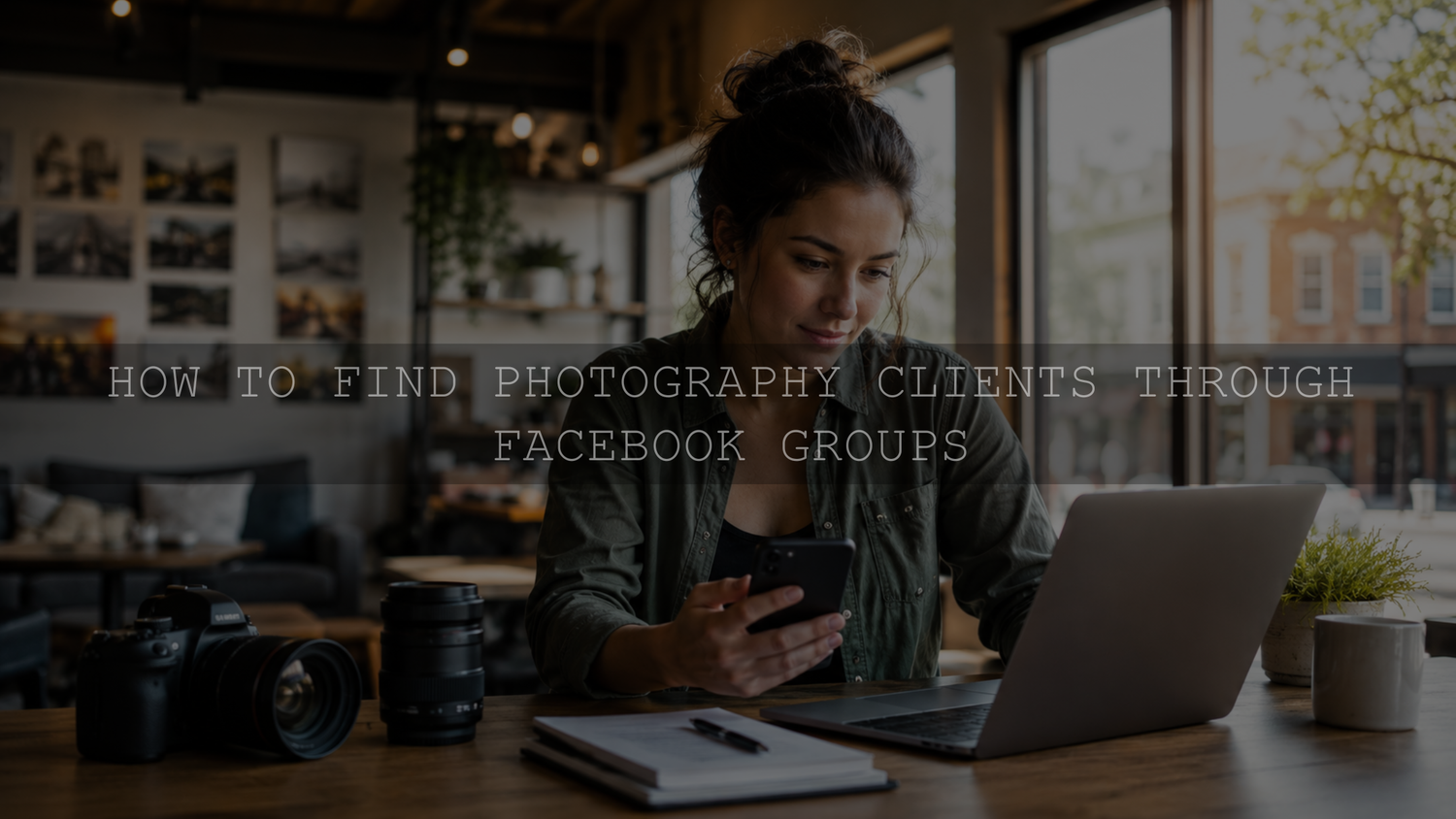
Facebook Groups can help photographers find potential clients when the groups contain people who genuinely need the service you offer. The goal is not to join as many groups as possible or repeatedly advertise your portfolio. It is to find relevant communities, listen for real photography needs, respond usefully when appropriate and move qualified inquiries into a booking process you control.
This can be a particularly relevant channel for photography services with a local or community component, such as families, newborns, graduations, weddings, events, pets, personal branding and some small-business photography. It is less useful when the people in a group have little connection to your service, location or buying process.
If you are still building the wider foundation around your offer and portfolio, begin with the AAAPresets guide to starting a photography business with no clients. This guide focuses specifically on using Facebook Groups as one client-acquisition channel.
Choose Facebook Groups Based on Client Fit, Not Member Count
A large group is not automatically a valuable group. Ten thousand members who are mostly photographers may generate fewer potential clients than a smaller neighbourhood group where local residents regularly ask for family, event or business recommendations.
Before joining a group, define the service you want to sell. A useful starting sentence is:
I photograph [service] for [type of client] in [location or service area] when they need [specific outcome].
Once that is clear, look for communities where those clients are likely to participate. Depending on your niche, useful groups may include:
- Local town, suburb and neighbourhood communities.
- Parent and family communities for family, maternity or newborn photography.
- Regional wedding-planning and wedding-vendor communities.
- Local small-business and entrepreneur groups for headshots, branding, product or hospitality photography.
- Pet-owner communities for pet photographers.
- Sports, hobby or community-event groups when the photography service directly relates to the activity.
- Local recommendation or community-service groups where members regularly request vendors.
Buy-and-sell groups can occasionally reveal local needs, but do not assume their rules permit advertising photography services. Facebook provides different group features, and each community can have its own rules, moderation and posting requirements.
Evaluate the Group Before Spending Time Marketing in It
After joining, review recent activity before posting anything. You are looking for evidence that the community contains potential buyers rather than simply a large audience.
Useful signals include recent requests for photographers, members asking for local vendor recommendations, questions about photography prices or availability, recurring seasonal requests and photographers being tagged by previous clients.
Also examine whether the group covers your actual service area. A highly active wedding group in a city several hours away may be less useful than a smaller group within the area you regularly serve.
If you want to measure local demand more systematically, the AAAPresets guide to researching photography demand in your local area explains how to separate weak engagement signals from stronger evidence such as qualified inquiries, consultations and paid bookings.
Read the Group Rules Before You Promote Anything
Do not assume membership gives you permission to advertise. Some Facebook Groups allow promotional posts regularly, others restrict them to particular days and some prohibit them completely.
Meta allows group administrators to create Facebook Group rules. Facebook also documents situations where administrators may require approval before someone can post or comment. Respect each community's rules and approval requirements even when you see other members ignoring them.
Check whether the community allows:
- Business promotion.
- Portfolio or website links.
- Business-page participation.
- Images in promotional posts or comments.
- Replies from service providers when another member requests recommendations.
- Promotional posts only on specified days or threads.
If the rule is unclear, ask an administrator rather than testing the boundary with an advertisement.
Use Facebook Group Search to Find Real Photography Requests
You do not have to rely entirely on whatever happens to appear in your feed. Facebook currently provides a way to search for posts within a group, although the exact interface can vary between devices and app versions.
Search using the language a potential client might naturally use rather than only the word “photographer.” Useful terms can include:
- Photographer.
- Family photos.
- Wedding photographer.
- Engagement photos.
- Newborn photos.
- Headshots.
- Graduation photos.
- Mini sessions.
- Product photos.
- Real estate photos.
- Recommendations.
- ISO photographer.
“ISO” usually means “in search of.” These requests can be valuable because the person has stated a specific need, but an ISO post is not automatically a qualified buyer. The date may no longer be open, their budget may not match your service, the location may be outside your area or they may still only be researching options.
Treat Older Posts Mainly as Market Research
Searching old conversations is useful because it shows what people repeatedly request, how they describe the service and which photographers are commonly recommended.
Be more careful about treating an old post as an active sales opportunity. A request from several months ago may already have been filled. Adding a promotional reply to a long-dead thread or sending an unsolicited private message can feel intrusive.
Use older posts primarily to learn:
- Which photography services appear repeatedly.
- What locations people mention.
- Whether clients ask about price, availability, style or turnaround.
- Which photographers receive repeated recommendations.
- What questions prospective clients ask before choosing someone.
- When demand becomes seasonal.
Respond directly only when the request still appears current and doing so is consistent with the group's rules and the member's invitation.
How to Respond to Photography Recommendation Posts
When someone posts a live request such as “Looking for a family photographer next month,” your goal is to help that person determine quickly whether you are relevant.
A useful response has four parts:
- Match the request. State the relevant service and area you cover.
- Show relevant proof. When the group permits it, include one strong example that resembles the type of work requested rather than an unrelated favourite photograph.
- Answer an important requirement. Mention availability, session type or another detail from the original request when you genuinely know it.
- Give one next step. Direct the person to your relevant portfolio, pricing or inquiry page, or invite them to contact you if they would like to check availability.
Example: “Hi — I photograph relaxed outdoor family sessions in the area you mentioned. I have availability during that part of the month, and my portfolio includes several sessions with the natural style you described. You can view the session details and pricing on my website, and I am happy to confirm availability if you send the date and approximate group size.”
The example is intentionally short. It answers the request rather than turning the comment into an autobiography.
Do Not Compete by Posting the Longest Comment
A recommendation thread may attract several photographers. More words will not necessarily make your response stronger.
Avoid posting only a raw website link because it gives the potential client little reason to understand why the link is relevant. At the other extreme, avoid a long biography, large list of equipment or generic claim that you can photograph anything.
Your strongest differentiator is usually relevant proof. A family client should immediately be able to find family work. A business owner looking for headshots should not need to search through weddings, pets and landscapes to determine whether you offer headshots.
Let the Potential Client Choose Whether to Move to Direct Messages
A public request does not automatically mean the member wants private messages from every photographer who reads it. Unless the post explicitly asks photographers to send a message, responding publicly first is often the cleaner approach.
If the person replies, messages you or completes your inquiry form, you can then move the conversation into a private channel and collect the information necessary to quote or confirm availability.
Be especially careful with content from private groups. Meta distinguishes between public and private Facebook Groups; access to content in private groups is restricted compared with public groups. Do not copy screenshots, names or personal details into your marketing or customer database simply because you can see them as a member.
Create Your Own Promotional Posts Only When They Are Allowed
When a group permits business promotion, avoid generic posts such as “Photographer available — book now.” Give members enough information to understand who the service is for and why it is relevant to their community.
A useful promotional post might explain:
- The photography service being offered.
- The location or service area.
- The type of client the session is designed for.
- What the session or package includes.
- When the offer is available.
- Where members can view relevant work and booking information.
A family photographer, for example, could announce a limited set of autumn sessions in a specific area and show an actual example of the style being offered. A branding photographer could explain a headshot or content-session option designed for local independent businesses.
Do not invent scarcity or claim that spaces are almost gone when they are not. A clear offer is more sustainable than manufactured urgency.
Participate Without Turning Community Activity Into a Performance
You do not need to spend weeks commenting on unrelated posts merely so you can later advertise. Participate when you have something genuinely useful to contribute.
That can include answering questions about preparing for a session, sharing information about photography locations when it is appropriate to do so, recommending another vendor when they genuinely fit or answering a photography question without immediately attaching a sales pitch.
The objective is not to manufacture friendship. It is to behave like a useful member of the community while making your professional role clear when it becomes relevant.
Move Facebook Leads Into a Professional Booking Process
Facebook can be the discovery source without needing to become your complete booking system.
Once someone becomes seriously interested, direct them toward a process where they can clearly see what you offer and where you can record the inquiry reliably. Depending on your business, that may include a website service page, pricing page, contact form, consultation or booking platform.
Before promoting heavily in local groups, make sure a potential client can answer:
- What type of photography do you offer?
- Where do you work?
- What does the finished work look like?
- What does the service include?
- What does it cost, or what determines the quote?
- How can the person check availability or inquire?
If your packages are difficult to explain in a Facebook comment, review whether the session type, location, deliverables, pricing or quotation method, turnaround and next step are clear enough for a prospective client to understand.
Respond Promptly, but Do Not Treat Speed as the Only Sales Strategy
A prospective client may contact several photographers, so unnecessarily slow replies can create friction. However, there is no reliable rule that the first photographer to respond automatically wins the booking.
A useful response is more important than a rushed one. Confirm the service, date, location and requirements before promising availability or quoting work that you do not fully understand.
For consumer sessions, you might need the date, number of people, preferred location and session type. For commercial work, you may need deliverables, intended usage, location, schedule, product quantity or production requirements before giving a meaningful quotation.
Encourage Referrals Without Asking Clients to Spam Groups
Past clients can become valuable referral sources because they can describe an experience that other members have not had.
After a successful delivery, it is reasonable to tell a client that you appreciate referrals. You might also say that if they happen to see a local photography request that genuinely fits your service, a recommendation or tag is appreciated.
Do not ask clients to repeatedly paste promotional messages into unrelated communities or pretend that an advertisement is an independent recommendation.
Track Whether Facebook Groups Produce Real Business
Group marketing can consume significant time because reading posts, replying and following conversations can feel productive even when the activity creates no revenue.
Create a simple record for each qualified opportunity and track:
- The Facebook Group or community where it originated.
- The photography service requested.
- The request date.
- Whether the lead matched your location and service.
- Whether the person made an inquiry.
- Whether a consultation or quote followed.
- Whether the inquiry became a paid booking.
- The approximate booking value.
- Any repeated objections or questions.
Do not collect unrelated personal information from community members. You only need enough business information to understand whether the channel is producing suitable inquiries.
After a meaningful test period, compare groups by qualified inquiries and bookings rather than comments, likes or member counts. One smaller community that produces suitable clients can be more valuable than several large groups that create attention but no relevant inquiries.
Common Facebook Group Marketing Mistakes
- Joining dozens of groups without defining the photography service being sold.
- Choosing groups because they are large rather than because the members fit the target client.
- Ignoring promotion rules or designated advertising days.
- Dropping the same portfolio link under every photography request.
- Using unrelated portfolio images when responding to a specific need.
- Sending unsolicited private messages to everyone who mentions photography.
- Reopening old threads as though the request is still active.
- Collecting or republishing information from private community conversations.
- Arguing publicly with photographers, administrators or potential clients.
- Claiming to be available or experienced in work you cannot reliably deliver.
- Counting likes and comments as evidence that the strategy is producing clients.
- Failing to record where actual inquiries and bookings originated.
When Facebook Groups May Not Be the Right Client Channel
Facebook Groups should be treated as one possible acquisition channel rather than a requirement for every photography business.
The strategy may have limited value when your ideal clients rarely participate in relevant groups, when local communities prohibit commercial activity, when your service is primarily business-to-business and purchased through a formal procurement process, or when the time required to monitor groups produces very few qualified inquiries.
It can also become risky to depend on one platform for your entire booking pipeline. Build a system that can also include your website, local search visibility, referrals, professional partnerships, email and other channels that suit your market.
Build a Repeatable Facebook Group Routine
You do not need to watch Facebook all day. A simple routine can be enough to test whether the channel deserves more attention.
- Choose a small number of groups that closely match your service and location.
- Read and follow the rules for each community.
- Search periodically for relevant photography requests.
- Respond only when your service genuinely fits the request.
- Show relevant portfolio proof rather than a generic sales message.
- Move serious inquiries into your normal website or booking process.
- Record qualified inquiries and paid bookings by source.
- Review the results and stop investing time in groups that consistently produce poor-fit leads.
Facebook Groups can be useful for photographers when they provide access to genuine local conversations and recommendation requests. The advantage is not guaranteed bookings or a hidden algorithm trick. It is the opportunity to hear what people need, respond when your work fits and build a direct path from that conversation to a professional inquiry.
Keep the process simple: choose relevant groups, respect community boundaries, search for real needs, show appropriate proof and measure bookings rather than attention.
Written by Asanka — creator of AAAPresets, serving more than 10,000 customers.


Leave a comment
This site is protected by hCaptcha and the hCaptcha Privacy Policy and Terms of Service apply.