

Choose a 35mm lens first if you mainly photograph street scenes, travel, family life, or people in their surroundings. Choose a 50mm lens first if you prefer tighter portraits, individual subjects, and simpler backgrounds. That advice applies to full-frame cameras. On APS-C, both lenses show a narrower field of view, so your camera's sensor size can change the recommendation.
The 35mm versus 50mm decision is not about which focal length produces more professional photos. It is about what fits in your frame, how much room you have to move, and which subjects you enjoy photographing. Here is how to choose without buying both just to find out.
35mm vs. 50mm Lenses at a Glance
- 35mm on full frame: A moderately wide view that includes more of the setting. Useful for travel, street photography, indoor family moments, and environmental portraits.
- 50mm on full frame: A narrower, standard view that makes it easier to simplify the frame. Useful for everyday portraits, individual subjects, food, and details.
- Background blur: A 50mm lens often makes background separation easier when other factors are comparable, but aperture, focus distance, and background distance matter too.
- Space required: A 35mm lens lets you include more from the same shooting position; a 50mm may require you to step back.
- Buying priority: Sensor format, lens mount, price, maximum aperture, autofocus, and size matter more than choosing a focal length based on reputation.
What Actually Changes Between 35mm and 50mm?
Focal length determines the angle of view: how much of the scene your camera records from a particular position. With the same full-frame camera and shooting position, a 35mm lens captures roughly 43% more scene width than a 50mm lens, assuming ordinary rectilinear lenses. The 50mm lens shows a tighter portion of that scene. For a manufacturer explanation, see Sony's guide to focal length and angle of view.
Imagine standing in a cafe photographing a friend at a table. At 35mm, you might include the cup, window, and neighboring chairs. At 50mm, the friend occupies more of the frame and fewer surrounding details fit. Neither composition is automatically better: one explains the place; the other directs attention toward the person.
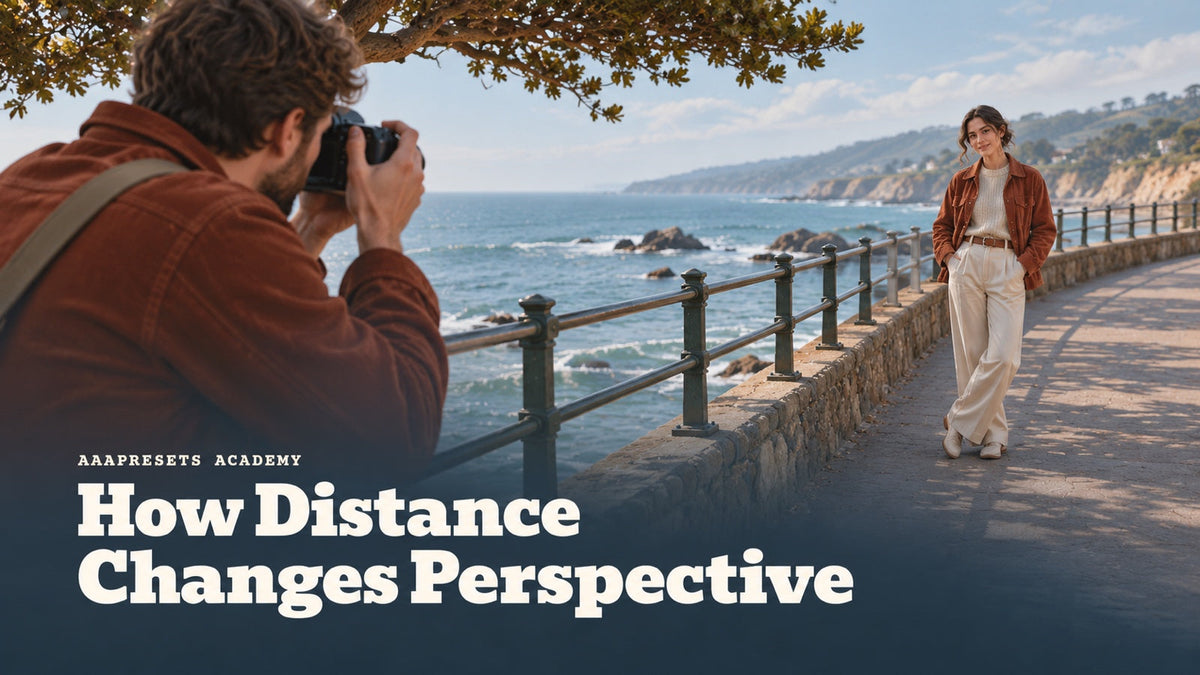
Changing focal length without moving the camera does not change perspective. The relative size of near and far objects stays the same from that position. The familiar change in facial proportions or background appearance happens when you move closer or farther away to keep the subject similarly framed. Lens design can also cause optical distortion, which is a separate issue.
When a 35mm Lens Is the Better First Prime
Choose 35mm if your photographs are often about people and the places around them. It offers enough width to show the environment while still letting a person remain the clear subject.
- Street and documentary photography: Include gestures, shopfronts, signs, and relationships between subjects without always retreating across the street.
- Travel and everyday life: Show a person in a market, at a cafe, or on a scenic path rather than isolating them from the location.
- Family photographs indoors: Fit more of a room or small group into the frame when stepping back is difficult.
- Environmental portraits: Use the surroundings to say something meaningful about a person's work, hobbies, or routine.
The trade-off is that you must pay closer attention to the frame edges. Bright objects, clutter, and people passing behind your subject can compete for attention. Also, moving extremely close for a tight face portrait can exaggerate the nose relative to the ears because of camera-to-subject distance. For flattering close-ups, leave some working distance rather than filling the frame from inches away.
A 35mm lens is not automatically wide enough for cramped interiors, large groups, or arm's-length vlogging. Those situations may call for a wider lens, especially if your camera records video with an additional crop.
When a 50mm Lens Is the Better First Prime
Choose 50mm if you often see a photograph as one clear subject against a quieter background. Its narrower field of view excludes some surrounding distractions without requiring an especially long lens.
- Individual portraits: Frame a person from the waist up or capture a relaxed head-and-shoulders portrait when you have enough room.
- Details and everyday objects: Concentrate on hands, food, shop displays, or small moments without including the whole room.
- Simple compositions: Narrow the scene when the surrounding environment does not contribute to the story.
- Experimenting with shallow depth of field: A 50mm f/1.8 can be an accessible way to practice focus placement and background separation, depending on your camera system.
The limitation is working distance. A 50mm prime can feel cramped at a dining table, in a small apartment, or when photographing several people. And although many 50mm f/1.8 lenses are relatively affordable, size, price, sharpness, and autofocus performance differ between specific models. A 50mm focal length alone guarantees none of those qualities. For an explanation of maximum aperture, see our guide to f-stops.
Portraits: Perspective and Bokeh Are Not the Same Thing
Camera distance controls facial perspective
If you photograph a face at 35mm and then switch to 50mm without moving, the 50mm image simply has tighter framing; the proportions of the face remain the same. If you move much closer with the 35mm to match the tighter composition, nearer facial features become relatively more prominent. That is a change in viewpoint, not a special distortion effect caused solely by the 35mm label.
For full-face close-ups, use a comfortable camera distance and select a lens that gives you the framing you need from there. For portraits showing a person in a meaningful location, the 35mm viewpoint may be exactly the point of the photograph.
Background blur depends on the entire setup
The maximum aperture matters: an f/1.8 lens usually allows a shallower depth of field than an f/4 lens of the same focal length at the same focus distance. Depth of field describes the range that appears acceptably sharp, while bokeh describes the look of out-of-focus areas. Focal length, subject distance, sensor format, and distance from the subject to the background also affect the amount of blur. A 50mm lens at a comparable aperture can produce stronger-looking background separation, but a fast 35mm is not automatically worse for portraits.
To test your setup, place the subject several feet in front of the background, focus on the eye nearest the camera, and compare photographs at the same aperture. If both eyes or several people need to be sharp, stop down rather than using the widest aperture simply because it is available.
Full Frame vs. APS-C: Check the Crop Factor Before Buying
The focal length engraved on a lens stays the same on different cameras. What changes with a smaller sensor is the part of the image recorded, producing a narrower field of view. Sony's lens guide linked above explains the approximately 1.5x APS-C crop factor; many Canon APS-C cameras use approximately 1.6x, as described in Canon's full-frame and APS-C comparison. For more about sensor formats, read our full-frame vs. APS-C guide.
- Full frame: 35mm looks like 35mm; 50mm looks like 50mm.
- 1.5x APS-C (such as many Sony, Nikon, and Fujifilm cameras): 35mm gives a view similar to 52.5mm on full frame; 50mm gives a view similar to 75mm.
- 1.6x APS-C (such as many Canon APS-C cameras): 35mm gives a view similar to 56mm on full frame; 50mm gives a view similar to 80mm.
If you want the 35mm full-frame look on a 1.5x APS-C camera, consider a lens around 23mm. For a 50mm full-frame view, look around 33mm. The exact available focal lengths vary by system. A 35mm prime can therefore be a useful standard lens on APS-C rather than a wide everyday lens.
Before buying, also check the camera's lens mount and whether the lens covers the sensor format. Matching the focal length is not enough to guarantee compatibility.
Can You Crop a 35mm Photo to Look Like 50mm?
Yes, to a degree. A photograph taken at 35mm can be cropped to approximately the field of view of a 50mm lens if the camera position stays the same. You would retain about 70% of the original width and height, or roughly 49% of the original pixels at the same aspect ratio. For example, a hypothetical 24-megapixel photo would leave about 12 megapixels after that crop.
This preserves the perspective but sacrifices resolution and does not recreate every optical characteristic of a separate 50mm lens. If you often crop almost every 35mm photo, that may be a useful sign that 50mm better fits your preferred framing.
Try Both Focal Lengths With the Zoom You Already Own
A standard zoom is often the easiest and most reliable way to choose your first prime. Try this short exercise before shopping:
- Pick equivalent focal lengths. On full frame, set your zoom to 35mm for one session and 50mm for another. On 1.5x APS-C, use roughly 23mm and 33mm to compare those same full-frame fields of view. If you are instead deciding between actual 35mm and 50mm lenses for APS-C, test those actual settings.
- Photograph normal subjects. Include an indoor scene, a person outdoors, and a street or travel-style composition. Keep the focal length fixed during each session.
- Record what feels limiting. Did you repeatedly run out of room with the tighter view? Did the wider view include distractions you could not avoid? These observations are more valuable than a generic recommendation.
- Compare fairly. First take two images from the same position to understand framing. Then move to achieve similar subject size and compare the resulting perspective and backgrounds.
- Check the actual lens models. Compare maximum aperture, autofocus reliability, close-focusing distance, weight, weather resistance, video focus breathing, price, and compatibility where these affect your work.
Do not expect a zoom at 35mm and f/4 to reproduce the depth of field of a 35mm f/1.4 prime. The experiment is mainly about field of view, composition, and working distance.
Think About Editing, Too
Lens choice shapes what is in the photograph; editing shapes how those elements look. A wider 35mm frame may contain window light, shade, and artificial lighting together, so white balance and distracting color casts deserve attention. A tighter 50mm portrait may make skin tones, highlight detail, and fine focus errors more noticeable.
Whether you edit manually or use a Lightroom preset as a starting point, review exposure, white balance, skin tones, and the important highlights for each photograph. No preset can recover a subject that was out of focus or replace an environment that was excluded from the frame.
Which Should You Buy First?
On full frame, buy a 35mm first for street, travel, everyday storytelling, and people in places; buy a 50mm first for tighter portraits and more selective compositions. On APS-C, base the decision on equivalent field of view rather than the number printed on the lens. If you already own a zoom, test your preferred framing before paying for a prime.
A well-chosen lens should solve a recurring problem in your photographs. If neither focal length fits the subjects you most often shoot, keep your zoom or consider another focal length instead of buying one because it is considered a classic.
Written by Asanka — creator of AAAPresets.


Leave a comment
This site is protected by hCaptcha and the hCaptcha Privacy Policy and Terms of Service apply.