
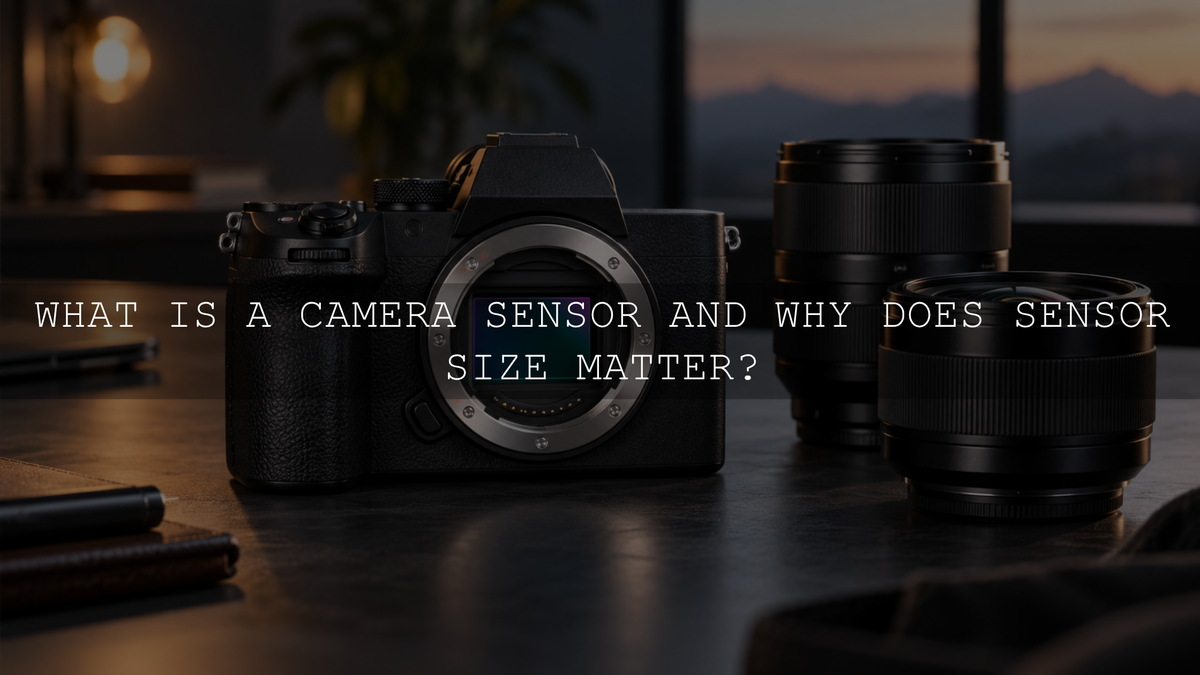
A camera sensor is the light-sensitive component inside a digital camera that receives the image projected by the lens and converts light into electrical signals used to build a digital photograph. Sensor size influences field of view, low-light potential, depth-of-field choices and camera-system design, but sensor size alone does not determine image quality.
Understanding the sensor makes it easier to compare terms such as full frame, APS-C, Micro Four Thirds, crop factor and megapixels. These specifications describe different parts of the imaging system, so separating them helps you compare cameras more accurately.
What Is a Camera Sensor?
A digital camera sensor is a semiconductor device positioned at the image plane inside the camera. It performs a role similar to photographic film in an analog camera: light focused by the lens reaches a light-sensitive surface where the image is recorded.
The sensor contains millions of light-sensitive sites commonly called photosites. During an exposure, photodiodes at those sites convert incoming light into electrical charge. The camera measures and digitizes those signals to create image data.
What happens next depends on the recording format. A RAW file stores sensor-derived image data with relatively limited in-camera processing, while JPEG and HEIF files normally receive additional processing such as white-balance rendering, sharpening, noise reduction and color conversion before they are saved.
It is also useful to distinguish a photosite on the physical sensor from a pixel in the finished digital image. The terms are often used loosely in everyday photography, but they describe different stages of the imaging process.
How Does a Camera Sensor Record Color?
Conventional image sensors primarily measure light intensity. Most color cameras therefore place a color filter array over the sensor so different photosites sample different parts of the visible spectrum.
A common arrangement uses red, green and blue filters. Each filtered photosite measures only part of the color information at its location, and the camera or RAW-processing software reconstructs missing color values from neighboring measurements through a process called demosaicing.
This is more accurate than saying that every individual photosite independently records complete red, green and blue information.
CCD vs CMOS Sensors
Two important image-sensor technologies are CCD, or charge-coupled device, and CMOS, or complementary metal-oxide-semiconductor.
CCD Sensors
CCD sensors convert light into electrical charge and traditionally transfer that charge through the sensor toward a shared readout circuit. CCD technology played a major role in earlier generations of digital photography and remains useful in some specialized imaging applications.
CMOS Sensors
CMOS sensors use a different readout architecture that integrates additional electronics with the sensor array. Compared with traditional CCD designs, CMOS technology can support lower power consumption and faster readout, which suits high-resolution photography, rapid burst shooting and video.
Most modern interchangeable-lens digital cameras use CMOS-based sensors. Backside-illuminated, stacked and partially stacked designs are variations in sensor architecture and readout design; they do not describe the physical sensor format itself.
Common Camera Sensor Sizes
Sensor format refers primarily to the physical dimensions of the light-sensitive imaging area. The formats below are among the most common in current photography.
| Sensor format | Approximate size | Typical use | Important consideration |
|---|---|---|---|
| Digital medium format | Varies; 43.8 × 32.9 mm is common, while some systems use larger sensors | Commercial, portrait, studio and landscape photography | Often paired with high-resolution cameras, but systems and files can be larger or more expensive |
| Full frame | About 36 × 24 mm | General enthusiast and professional photography and video | Reference format for many crop-factor comparisons |
| APS-C | About 24 × 16 mm, with manufacturer variations | General photography, travel, wildlife, sports and hybrid shooting | Can support smaller systems and gives a narrower field of view than full frame with the same focal length |
| Micro Four Thirds | 17.3 × 13.0 mm | Travel, video, wildlife and compact interchangeable-lens systems | Uses a 2× crop-factor comparison relative to full frame |
| 1.0-type | About 13.2 × 8.8 mm | Premium compact and fixed-lens cameras | Smaller sensor area can help keep cameras and lenses compact |
| Smartphone and other small sensors | Varies considerably by device | Phones, compact imaging devices and computational cameras | Lens design and computational processing can be as important as sensor size |
Digital medium format is not one exact sensor size. For example, several current medium-format systems use sensors around 43.8 × 32.9 mm, while other systems use larger imaging areas.
What Is Crop Factor?
Crop factor is a way to compare the field of view produced by different sensor formats using full frame as a reference.
When the same compatible lens is used from the same camera position, a smaller sensor records a narrower field of view than a larger sensor. For example, a 50 mm lens used on a camera with a 1.5× APS-C crop factor gives approximately the same field of view as a 75 mm lens on a full-frame camera.
The 50 mm lens remains a 50 mm lens. Crop factor does not physically increase its focal length; it changes the field of view recorded by the camera.
Does a Crop Sensor Give You More Reach?
Photographers often describe APS-C and Micro Four Thirds cameras as providing extra reach for wildlife or sports. That shorthand can be useful for framing, but it should not be confused with optical magnification.
A smaller sensor records a narrower field of view. Whether it also places more usable pixels on a distant subject than another camera depends on factors such as pixel density, sensor resolution and the resolution of the lens.
Does a Larger Sensor Perform Better in Low Light?
A larger sensor has more total light-sensitive area. When cameras of comparable technology are used under equivalent shooting and output conditions, that larger collecting area can provide a signal-to-noise advantage and more flexibility in low light.
Sensor size is not the only factor affecting noise, however. Resolution, photosite design, sensor generation, readout electronics, exposure, lens aperture and image processing all matter.
A larger sensor also does not automatically mean that each individual photosite is larger. A high-resolution large sensor can use smaller photosites than a lower-resolution sensor of similar dimensions.
For practical comparisons, look at the performance of the specific cameras you are considering rather than assuming sensor size alone predicts high-ISO image quality.
How Sensor Size Affects Depth of Field
Larger formats are often associated with stronger background blur and shallow depth of field, but the sensor itself does not directly blur the background.
The difference becomes apparent when photographers match framing and perspective between formats. A larger format generally requires a longer focal length to achieve the same field of view from the same camera position. At the same f-number, that combination can produce shallower depth of field.
Smaller formats can make it easier to keep more of the scene acceptably sharp at equivalent framing. Neither characteristic is automatically better: portraits may benefit from easier background separation, while landscapes, travel photography or close-up work may benefit from greater depth of field.
Does Sensor Size Affect Dynamic Range?
Dynamic range describes the span between the darkest useful tones and the brightest tones a camera can record before important information is lost to noise or clipping.
Larger sensors can have an advantage when technology and output are otherwise comparable, but dynamic range is not determined by sensor dimensions alone. Sensor architecture, photosite design, readout noise, ISO setting and processing can all influence measured performance.
For that reason, compare the dynamic-range performance of specific camera models rather than assuming that every full-frame camera will outperform every APS-C or Micro Four Thirds camera.
Sensor Size vs Megapixels: What Is the Difference?
Sensor size describes physical area. Megapixels describe the number of pixels used to form the recorded image.
A 24-megapixel full-frame camera and a 24-megapixel APS-C camera can therefore have the same nominal image resolution while using sensors with substantially different physical dimensions. Likewise, two full-frame cameras can use the same sensor format while having very different megapixel counts.
Higher resolution can provide more fine detail and additional cropping flexibility when the lens, focus accuracy, shutter speed and shooting conditions support it. More megapixels do not automatically guarantee better overall image quality.
Does a Bigger Sensor Mean a Bigger Camera?
Not necessarily, although sensor format influences the design of the complete camera system.
A lens must project an image circle large enough to cover the sensor. Larger formats can therefore require larger lens elements, especially when wide apertures, long focal lengths or demanding optical performance are involved.
Smaller formats can make compact bodies and lenses easier to design, but individual products vary. A compact full-frame body can be smaller than some APS-C or Micro Four Thirds bodies, while the lenses needed for equivalent coverage or aperture may still make the complete kit larger.
The more useful comparison is the complete body-and-lens combination you would actually carry.
Which Camera Sensor Size Should You Choose?
There is no single sensor format that is right for every photographer. Choose according to the subjects you shoot, the lenses you need, the conditions you work in and the size and cost of the complete system.
Consider Full Frame When:
- You frequently work in low light and the specific full-frame cameras you are comparing provide the performance you need.
- You often want shallow depth of field for portraits or video.
- The lenses you need are available in the full-frame system you are considering.
- The additional system size and cost fit your priorities.
Consider APS-C When:
- You want a balance of image quality, camera size and cost.
- You photograph wildlife, sports or travel and value a narrower field of view from a given focal length.
- You want an interchangeable-lens system without moving to full frame.
- You need strong photo and video features in a relatively compact kit.
Consider Micro Four Thirds When:
- Portability and smaller lenses are major priorities.
- You shoot travel, documentary work, wildlife or video.
- You value greater depth of field at equivalent framing.
- You want a compact interchangeable-lens system with broad focal-length coverage.
Consider Digital Medium Format When:
- You need very high-resolution files and the specific camera offers the image characteristics your work requires.
- You frequently shoot commercial, studio, portrait or landscape photography.
- You are comfortable with the cost, file sizes and workflow of the system.
- Portability and high burst rates are less important than the strengths of the particular medium-format camera you are considering.
Consider a Smartphone or Compact Camera When:
- You prioritize portability and convenience.
- You prefer a fixed-lens or always-with-you camera.
- You value computational photography and automatic multi-frame processing.
- Ease of carrying the camera matters more than maximizing sensor area.
What Matters More Than Sensor Size?
Sensor format is only one part of the photographic system. Before choosing a camera, also consider lens availability, autofocus, stabilization, ergonomics, video features, battery life, resolution, sensor readout speed, file sizes, weather sealing, storage requirements and overall cost.
Technique and lens choice can also have a major effect on the final photograph. A smaller-sensor camera paired with the right lens for your subject may be more useful than a larger-sensor body that leaves too little budget for the lenses, lighting or accessories you actually need.
Final Thoughts
A camera sensor captures the light used to create a digital photograph, but its physical size is best understood as one design trade-off rather than a universal quality ranking.
Full frame offers a larger imaging area and can make shallow depth of field easier to achieve at equivalent framing. APS-C provides a practical middle ground for many interchangeable-lens systems. Micro Four Thirds can support compact camera-and-lens combinations, while digital medium-format systems offer larger imaging areas and are often built around high-resolution capture. Smartphones use much smaller sensors but combine them with increasingly sophisticated computational processing.
Instead of asking which sensor size is universally best, compare the complete camera-and-lens system with the subjects you photograph, the conditions you work in, the output you need and the amount of equipment you are comfortable carrying.

Leave a comment
This site is protected by hCaptcha and the hCaptcha Privacy Policy and Terms of Service apply.