
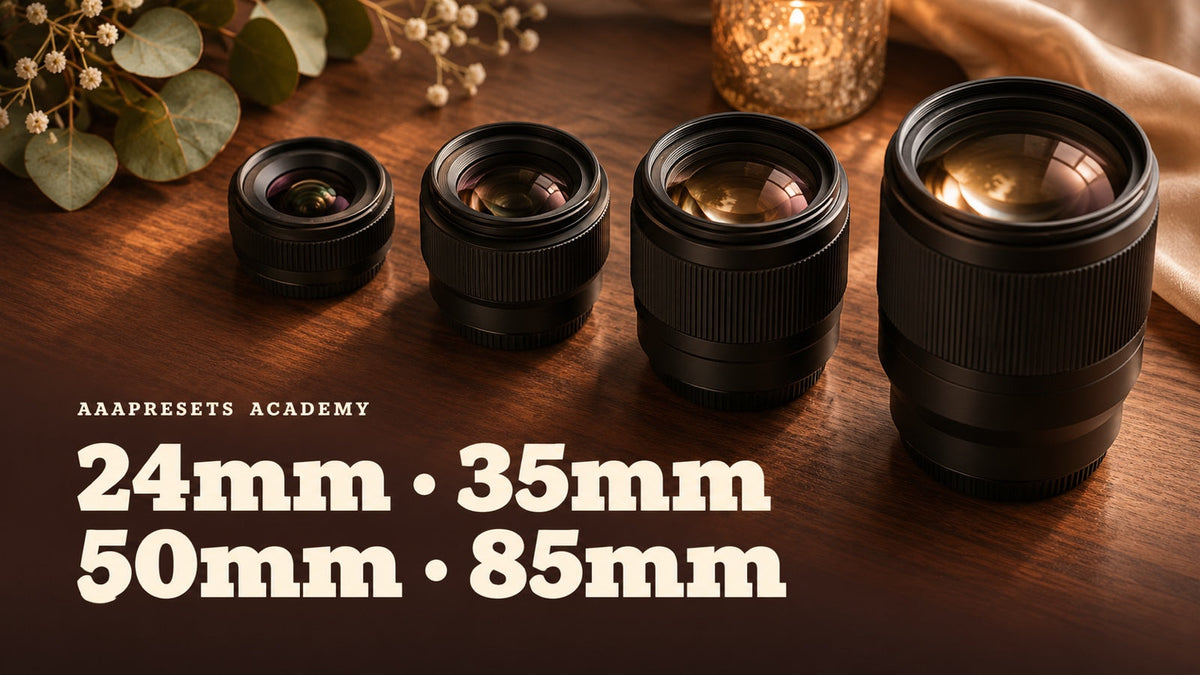
A wide-angle lens captures a broader view of a scene than a standard lens, making it useful for landscapes, architecture, interiors, travel photography, and large groups. On a full-frame camera, focal lengths around 24–35mm are generally considered wide-angle, while lenses around 14–20mm are often described as ultra-wide. The best choice depends on how much of the scene you need to include—and how you want nearby and distant subjects to relate to each other.
Going wider is not automatically better. The additional space can add depth and context, but it can also make a distant subject look tiny or bring distracting elements into the frame. Here is how to choose and use a wide-angle lens intentionally.
What Counts as a Wide-Angle Lens?
A lens's focal length, measured in millimeters (mm), helps determine its angle of view. On the same camera sensor, a shorter focal length records a wider view; a longer focal length records a narrower one. Nikon's guide to focal length identifies roughly 14–35mm as the wide-angle range for full-frame cameras.
- 35mm: A moderate wide-angle perspective for street photography, travel, documentary work, and environmental portraits.
- 24mm: A versatile choice for landscapes, travel scenes, architecture, and group photographs where space is limited.
- 20mm: A noticeably wider view that suits expansive landscapes, tight interiors, and night-sky photography.
- 14–16mm: An ultra-wide look that captures very large scenes but requires extra attention to edges, composition, and straight lines.
These ranges are practical descriptions, not strict industry boundaries. A 24mm lens can feel very wide indoors yet relatively restrained beside a 14mm lens.
What About APS-C Cameras?
Sensor size changes the field of view recorded by a lens. On a typical 1.5× APS-C camera, a 16mm lens gives roughly the same angle of view as a 24mm lens on full frame. On many Canon APS-C cameras with a 1.6× crop factor, it is closer to a 26mm full-frame-equivalent view. The lens itself remains 16mm; only the framing changes. For more context, see our full-frame versus APS-C guide.
When Should You Use a Wide-Angle Lens?
- Landscape and nature photography: Include foreground textures, a mountain range, and dramatic skies in the same frame. Wide-angle lenses are especially effective when a nearby object leads the eye into the scene.
- Architecture and city scenes: Photograph tall buildings, narrow streets, or large interiors when stepping farther back is not possible. Keep an eye on converging vertical lines.
- Real estate and interiors: Show a room's layout and its relationship to windows, furniture, and other spaces. Avoid going so wide that the room appears misleadingly large.
- Travel and documentary photography: Include enough surroundings to show where an event or person belongs in the story. A 24mm or 35mm view can feel immersive without overwhelming the subject.
- Groups, vlogging, and environmental portraits: Fit more people or background into the frame. Keep faces away from the extreme corners when possible.
- Astrophotography: Photograph broad sections of the star field or Milky Way. A wide lens with a large maximum aperture can help, but accurate focus, exposure, and dark skies remain essential.
Why Wide-Angle Photos Can Look So Dramatic
Wide-angle photographs often make a nearby rock, doorway, or person appear prominent while a distant mountain or building seems smaller and farther away. This effect is mainly about camera position. Photographers using a wide lens frequently move closer to the foreground to fill the frame, and that shorter distance makes near objects appear larger relative to the background.
Changing focal length without moving the camera does not by itself change the underlying perspective. If you take a 20mm photograph and crop its center to match a tighter view from the same position, the relative sizes and alignment of objects stay the same, apart from differences such as lens distortion. Canon's perspective reference illustrates the expansive look commonly associated with wide focal lengths.
This distinction explains why a wide-angle lens does not automatically make a composition exciting. You need an intentional viewpoint and an interesting relationship between foreground, middle distance, and background.
How to Compose Better Wide-Angle Photos
- Choose the subject first. Decide whether the photograph is about a person, building, landscape feature, or atmospheric setting. A wide field of view still needs a clear visual purpose.
- Use a foreground when it adds meaning. A path, rock formation, patterned floor, or reflection can create scale and lead the viewer into the frame. Do not add a foreground object merely because the lens is wide.
- Move your feet before changing the zoom. Try a higher or lower viewpoint, and move closer only when doing so improves the relationship between subject and background.
- Check all four corners. Look for unwanted people, signs, camera straps, bright distractions, and awkwardly stretched objects.
- Keep important faces away from the extreme edges. The outer parts of a rectilinear ultra-wide image can stretch people noticeably, especially in close group photographs.
- Review the result at full size. Check the nearest important detail, the main subject, and the distant background instead of judging sharpness from a small camera preview.
Practical Camera Settings for Wide-Angle Photography
There is no universal wide-angle camera setting. The right exposure depends on light, subject movement, focusing distance, and how much of the scene must be acceptably sharp.
- Daylight landscapes: Try f/8–f/11 as a starting range, use a low ISO when practical, and choose a shutter speed that prevents camera shake. A tripod helps when the required shutter speed becomes slow. Our landscape aperture guide explains when stopping down farther or using focus stacking makes sense.
- Indoor group photographs: Start around f/4–f/8, adjusting for how many rows of people need to remain sharp. Choose a shutter speed fast enough for people who may move, and raise ISO or add light if needed. See our group-photo aperture guide for more specific setups.
- Night skies: A wide maximum aperture such as f/1.8 or f/2.8 can help gather light. Verify focus on stars and keep exposures short enough for the focal length and your tolerance for star trailing.
Wide lenses often make it easier to obtain substantial depth of field, but they do not keep everything sharp automatically. A very close foreground at a wide aperture can still be blurred. For a deeper explanation, read how focal length affects depth of field.
Three Types of Distortion to Watch For
1. Perspective Exaggeration
When the camera is close, nearby objects can appear disproportionately large compared with distant ones. This may be useful for a dramatic foreground, but it can be unflattering for close-up faces. Step back and reframe when proportions matter more than immersion.
2. Converging Vertical Lines
Pointing a camera upward at a tall building can make its sides appear to lean toward each other. Keeping the camera more level reduces this effect. Perspective-correction tools can help afterward, although corrections may require cropping the edges.
3. Optical Distortion and Edge Stretching
Some lenses bend straight lines near the frame's edges, often described as barrel distortion. A suitable lens profile can help correct this optical behavior. Rectilinear ultra-wide photographs can also make objects near the corners appear stretched; lens-profile correction does not necessarily remove that appearance. Compose with extra space around important subjects rather than expecting editing to solve every edge problem.
Wide-Angle Prime vs. Zoom: Which Should You Choose?
A wide-angle zoom, such as a 16–35mm, provides a flexible range for travel, landscapes, and architecture. It is useful when you need to adapt quickly or cannot move freely.
A wide-angle prime, such as a 20mm or 24mm, provides one fixed focal length. Some primes are compact and offer large maximum apertures, making them attractive for low-light work and night photography. However, a prime is not automatically sharper, lighter, or better than every zoom.
Choose the lens that solves your most frequent framing problem. For hiking and general travel, zoom flexibility may matter most. For a consistent documentary style or star photography, a well-chosen prime may be more appealing.
How to Edit Wide-Angle Photos Naturally
Wide-angle frames often include a bright sky, deep foreground shadows, and a broad range of colors. Editing can improve balance, but it should not hide the photographer's original composition.
- Correct geometry first: Check whether lens-profile correction or vertical alignment is appropriate, especially for buildings and interiors.
- Revisit the crop: Remove distracting edge details while protecting the subject and useful foreground. Leave extra space at capture time if perspective corrections will be needed.
- Balance bright and dark areas: Adjust overall exposure, highlights, and shadows. When needed, refine the sky or foreground separately so neither looks unnaturally flat.
- Check color and fine detail: Review white balance, greens, blues, and any skin tones. Avoid sharpening skies or pushing saturation until clouds and foliage look artificial.
For landscape and travel editing, AAAPresets Lightroom Presets for Landscapes & Travel offers eight looks supplied in XMP and DNG formats. The pack is designed as an editable starting point rather than a substitute for correcting exposure, white balance, or perspective for each photograph.
A Simple Wide-Angle Practice Exercise
Choose a scene with a clear foreground and a recognizable background, such as a pathway leading toward a building or a rock beside a distant hill.
- Photograph it at 24mm and 35mm from the same camera position, if your lens covers both focal lengths.
- Compare the framing. Notice that the perspective relationship remains the same while the wider image includes more surroundings.
- Return to 24mm, move closer to the foreground, and photograph the scene again.
- Compare how the relative size of the foreground and background now changes because your position changed.
- Finally, check the edges and try a small adjustment to your camera height or angle.
This short exercise teaches the key skill behind stronger wide-angle images: using camera position to control visual relationships, instead of simply fitting more into the photograph.
The Bottom Line
A wide-angle lens is most useful when the setting is part of the story. Start with a focal length that includes what matters, choose your viewpoint deliberately, watch the edges, and use exposure settings suited to the subject. An intentional 24mm photograph can be more effective than an ultra-wide shot that includes everything but emphasizes nothing.
Written by Asanka Dilshan — founder of AAAPresets.


Leave a comment
This site is protected by hCaptcha and the hCaptcha Privacy Policy and Terms of Service apply.