

Lens compression is the appearance of distant objects looking closer to a foreground subject than they really are. You often notice it in telephoto portraits, crowded street scenes, and landscapes where mountains seem to rise dramatically behind a person. The important detail is that camera position creates the perspective; a long lens simply makes it easier to frame a tight photograph from farther away.
Understanding that distinction helps you choose where to stand, which focal length to use, and what kind of background to include. It also explains why changing lenses without moving the camera cannot, by itself, change the relative sizes of objects in the scene.
What Is Lens Compression in Photography?
Lens compression, also called perspective compression or telephoto compression, describes a photograph in which objects at different distances appear more similar in size and closer together. A distant mountain might look enormous behind a person, or several rows of buildings might appear densely stacked.
The scene has not physically changed. The apparent effect comes from the relationship between your viewpoint, the foreground subject, and the background. As Fujifilm's explanation of lens compression points out, a longer focal length does not independently change perspective. It changes how much of the scene fits inside the frame.
Why Camera Distance Makes the Background Look Bigger
Perspective depends on the relative distances from the camera to different objects. When the camera is close to a foreground subject, the background may be much farther away by comparison. When the camera moves back, that extra distance becomes a smaller proportion of the total distance to both objects.
Consider a simplified example with two equally tall signs, one standing 10 metres behind the other:
- If the camera is 10 metres from the front sign, the second sign is 20 metres away. The distant sign appears approximately half as tall as the nearer one.
- If the camera moves to 100 metres from the front sign, the second is now 110 metres away. The distant sign appears roughly 91% as tall as the front one.
That change in relative apparent size is the basis of perspective compression. The signs have not moved closer to each other. You have changed your viewing position.
Does a Telephoto Lens Actually Cause Compression?
No. A telephoto lens does not change perspective when the camera stays in the same position. If you photograph a scene at 35mm and 135mm without moving, the second image shows a narrower field of view. Cropping the 35mm image to match the 135mm framing gives essentially the same perspective and relative object sizes, although image detail, depth of field, and other optical characteristics may differ.
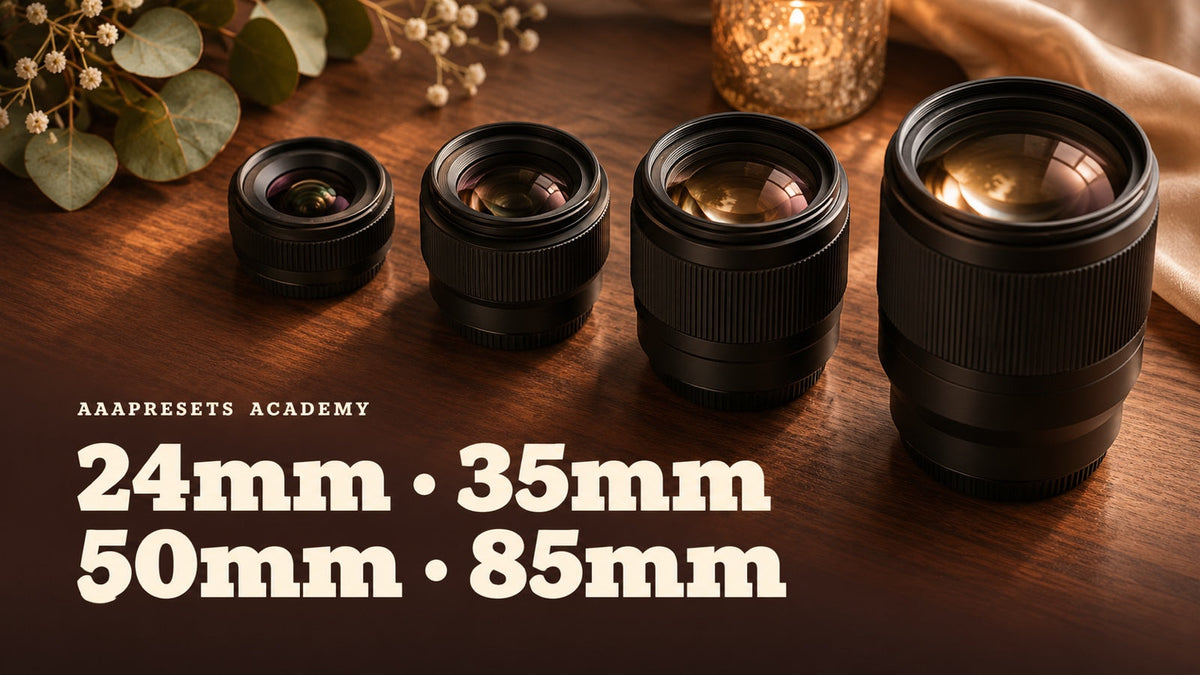
Why, then, is compression strongly associated with 85mm, 135mm, and 200mm lenses? Because photographers normally move backward to keep a person or other foreground subject the same size in the frame when switching to a longer focal length. Moving backward changes perspective, while zooming in restores the desired framing.
Think of the two controls separately: your position determines the relationship between near and far objects; your focal length determines how much of that view you record.
A Simple Experiment to See Lens Compression
You can demonstrate both effects using a zoom lens and a stationary person standing well in front of a tree, building, or distant hillside.
- Make a wide photograph. Stand reasonably close to the person and photograph them at a wider focal length, such as 35mm on a full-frame camera.
- Keep the person in place. Move several metres backward, then zoom toward 85mm, 135mm, or a longer setting until the person occupies approximately the same portion of the frame.
- Compare the backgrounds. In the second photograph, the background object should appear larger relative to the person if its distance makes the change noticeable.
- Test focal length alone. Return to one fixed camera position and photograph the scene at wide and long settings. Crop the wider photograph to match the tighter framing. The perspective should line up closely.
- Control other variables. Keep the camera at a similar height, focus on the same subject, and choose an aperture that provides sufficient sharpness. This makes perspective easier to compare without confusing it with blur.
A large, recognizable background object usually makes the demonstration clearer than a plain wall. If the person and background are almost the same distance from the camera, there will be much less visible change.
How Photographers Use Compression Creatively
- Portrait photography: Stepping back and using a suitable longer focal length can create natural-looking facial proportions in a close portrait and make a distant background more prominent. On full-frame cameras, 85mm to 135mm is a common working range, but other focal lengths can work too.
- Landscape photography: Photographing from farther away can make mountains, cliffs, or a distant skyline look imposing behind a relatively small foreground subject. A longer lens helps isolate the relationship you want viewers to notice.
- Street scenes and architecture: A distant viewpoint can make repeated streetlights, pedestrians, or building facades appear densely layered. Watch how these overlapping elements affect the visual story.
- Sports and wildlife: Long lenses let you frame subjects that cannot safely or practically be approached. Perspective compression becomes noticeable when foreground and background objects occupy different distances within the scene.
For a more dramatic result, choose a background with a clear shape, find a viewpoint that places it behind your subject, and adjust your distance before finalizing the framing. Tamron's guide to the compression effect also illustrates how changing the shooting distance affects the apparent relationship between subjects and backgrounds.
Lens Compression vs. Background Blur and Distortion
Compression and background blur are not the same thing. Compression changes the apparent size relationship between objects because of perspective. Background blur describes how far out-of-focus parts of a scene appear, influenced by aperture, focusing distance, focal length, subject-to-background separation, and framing. You can photograph a strongly compressed landscape with a relatively sharp background. For more detail on this distinction, see our guide to how focal length changes depth of field.
Likewise, a close-up face photographed from very near the camera may have an exaggerated nose-to-ear size relationship because of perspective. Stepping back changes those proportions. A longer lens is helpful for maintaining a tight headshot from that distance, but it is not directly reshaping the face. This is separate from optical effects such as barrel or pincushion distortion, which depend on lens design and correction.
Can Editing Create Lens Compression?
Cropping a photograph can emphasize a compressed-looking arrangement that was already present, especially if the original camera position was distant enough. However, cropping, Lightroom presets, and color grading cannot change the original relative perspective between your subject and background. Creating a different relationship requires capturing the scene from a different viewpoint or making more involved image composites.
Once the composition is right, refine exposure, white balance, highlights, shadows, and color to support the mood. In a portrait, take care that adjustments to contrast and clarity do not distract from natural-looking skin. Editing should enhance the photograph you captured, not replace the decision about where to stand.
Frequently Asked Questions
Can a smartphone create lens compression?
Yes. Move farther from the foreground subject to change perspective, then use a telephoto camera if available or crop the image to tighten the composition. Heavy digital zoom or cropping may reduce image detail, so the result depends partly on your phone's camera and resolution.
Does an APS-C camera create more compression than full frame?
Not from the same viewpoint. A smaller sensor records a narrower portion of the image from a given focal length, but does not independently alter perspective. Differences appear when photographers change their shooting distance to achieve matching compositions with different camera formats. See our crop sensor vs. full frame comparison for more on field of view.
The Key Takeaway
Choose your camera position for perspective, then choose your focal length for framing. If you want a distant background to appear larger relative to your subject, move farther away and use a tighter field of view. If you want greater apparent depth, move closer with a wider view. Once you separate those decisions, lens compression becomes a repeatable compositional technique rather than a mysterious property of expensive glass.
Written by Asanka — creator of AAAPresets.


Leave a comment
This site is protected by hCaptcha and the hCaptcha Privacy Policy and Terms of Service apply.