
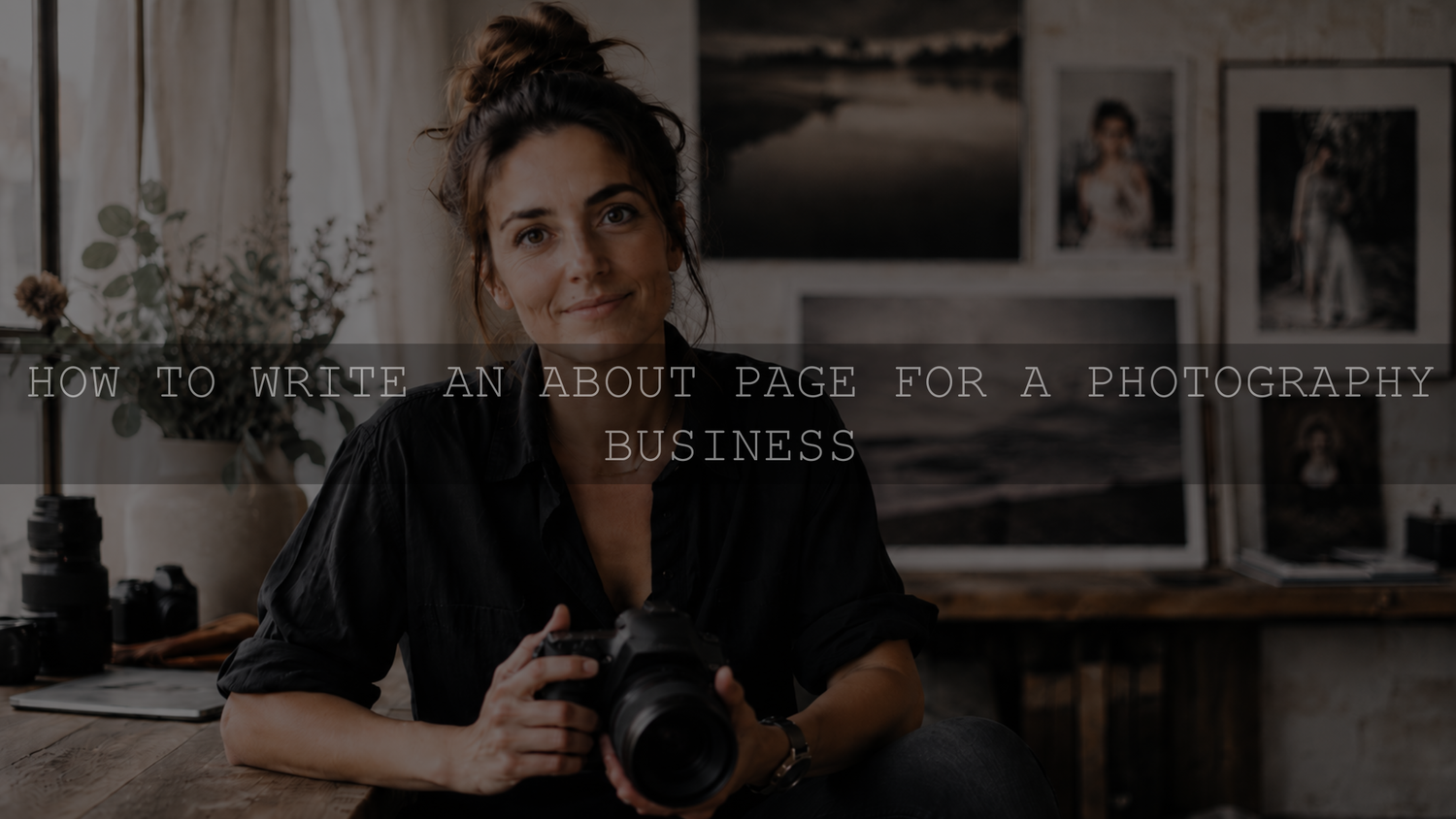
A photographer About page should help a potential client understand more than your life story. It should explain who you are, what you photograph, who you serve, what working with you is likely to feel like and where the visitor should go next.
The strongest page is usually a balance of professional relevance and genuine personality. You do not need to sound corporate, but you also do not need to turn the page into a list of hobbies and fun facts. Give a qualified visitor enough useful context to decide whether your photography and approach fit what they need.
What a Photographer About Page Should Answer
Before writing paragraphs, make sure the page can answer five practical questions:
- Who are you? Give your name or studio identity and make it clear who is behind the work.
- What do you photograph? State your main specialty or the work you most want to book.
- Who or where do you serve? Mention the relevant client type and service area when location affects the booking.
- What is it like to work with you? Explain enough of your approach to reduce uncertainty about the experience.
- What should the visitor do next? Guide the reader toward your portfolio, services, availability or inquiry process.
If your specialty is still unclear, define that before writing the bio. The AAAPresets guide to choosing a photography niche can help you clarify the work and clients you want your website to attract.
1. Start With a Clear Client-Facing Introduction
Your first paragraph does not need a dramatic origin story. Start by telling visitors who you are and giving them enough context to understand your work.
A useful opening structure is: I’m [name], a [photography specialty] photographer serving [location or client type]. I help [type of client] create [relevant outcome or experience].
For example, a family photographer might introduce themselves around relaxed outdoor sessions for families in a particular region. A commercial photographer might immediately explain that they create product and lifestyle photography for independent brands. The wording will change with the business, but the purpose stays the same: remove uncertainty quickly.
Avoid opening with generic statements such as “Photography has always been my passion” unless the sentence leads somewhere specific. A visitor learns more from knowing what you photograph, whom you serve and what distinguishes the experience.
2. Explain What Working With You Is Like
A portfolio can demonstrate the finished visual style, but it cannot always explain the experience on the other side of the camera. Your About page is a useful place to describe your working approach.
Depending on your service, this might include:
- Whether you give detailed posing direction or use a more documentary approach.
- How much planning happens before the session.
- Whether sessions are structured, relaxed, fast-paced or collaborative.
- How you help clients prepare.
- What you pay particular attention to while photographing.
Be specific rather than relying on broad claims such as “I make everyone comfortable.” For example, a portrait photographer could explain that they demonstrate poses, adjust hands and posture and keep giving direction throughout the session. A documentary wedding photographer might instead explain that they keep intervention limited during important moments while giving more guidance for portraits.
Those descriptions tell the visitor what the words “relaxed,” “candid” or “guided” actually mean in practice.
3. Use Your Origin Story Only When It Adds Meaning
You can absolutely explain how you became a photographer, but the complete history is rarely necessary.
Choose the parts of the story that explain something relevant about the photographer you are now. A useful origin story might reveal why you specialize in a particular subject, why you photograph in a particular way or what led you to build the service you currently offer.
For example, the important part may not be that you received your first camera at a certain age. The more relevant story could be how photographing small businesses led you to focus on commercial brand photography, or how documenting your own family changed the way you approach family sessions.
If the story does not help the prospective client understand your work, values or approach, it can usually be shortened.
4. Add Personality, but Give Every Detail a Reason to Be There
Personal details can make an About page sound human rather than interchangeable, but more personal information is not automatically better.
Use a simple test for each detail: does this help the right client understand me, remember me or feel more prepared to work with me?
Useful details could include:
- A genuine interest that connects naturally with the photography you offer.
- Local knowledge that matters for location-based sessions.
- An interest in hiking if outdoor adventure sessions form an important part of the business.
- Languages you can genuinely use with clients.
- A small personal detail that gives readers an easy conversation starter.
A coffee order, favorite film or pet can still be included if it reflects your real personality. It simply should not take up more space than the information a client needs to make a hiring decision.
5. Include Credibility You Can Actually Prove
An About page is also a reasonable place to establish relevant professional credibility. The key is accuracy.
Depending on what is genuinely true for your business, useful proof might include:
- Relevant years of experience.
- A verified number of assignments or clients served.
- Genuine awards or professional qualifications.
- Recognized publications or exhibitions.
- Relevant memberships.
- A short client testimonial.
- Specialized experience that matters to the service you provide.
Do not add an impressive-sounding number simply because other photographers use one. If you cannot verify a claim, leave it out or describe your experience without inventing a statistic.
The same applies to titles such as “award-winning,” “internationally published” or “leading photographer.” Use them only when you can substantiate what they mean.
6. Show a Portrait That Helps Clients Recognize You
If clients will interact with you personally, include at least one clear and current portrait that makes you recognizable. It does not need to resemble a formal corporate headshot. The photograph can reflect the visual identity of your business while still showing the person behind it clearly.
A behind-the-scenes photograph of you holding a camera can be useful as a secondary image, but consider whether it works as the only photograph if your face is hidden completely.
Update the image when it no longer represents your appearance or brand well rather than following an arbitrary replacement schedule.
Prepare the file carefully for the website so it remains sharp without being unnecessarily heavy. The AAAPresets guide to preparing edited photos for a portfolio website covers resizing, compression, color space and web delivery in more detail.
7. Choose First Person or Third Person for a Reason
First-person writing usually feels natural for a solo photographer because the visitor is hearing directly from the person they may hire:
“I’m Alex, a wedding photographer based in…”
Third person is not automatically wrong. It can make sense for a studio with several photographers, a formal biography that also needs to work for publications or speaking engagements, or a page written about a team rather than one person.
The important thing is consistency. Do not switch randomly between “I,” “we” and your own name. If you operate alone, avoid using “we” simply to make the business sound larger.
If you are still deciding whether the public brand should use your personal name or a separate studio identity, see the guide to choosing between your name and a studio name.
8. Include Your Specialty and Service Area Naturally
Your About page should be understandable without forcing search phrases into every paragraph. If location affects whether someone can hire you, say where you are based or where you normally work. If you specialize in one kind of photography, state that clearly as well.
A descriptive page title might follow a structure such as “About [Name] | Wedding Photographer in [Location]” when both specialty and location genuinely describe the business.
Google’s guidance for title links recommends descriptive, concise title text and warns against keyword stuffing. Write for someone deciding whether the page is relevant rather than trying to fit every search variation into the title.
Your portrait and other meaningful photographs should also have useful alt text. Describe the image in context rather than filling the alt attribute with service keywords. Google provides additional guidance in its image SEO best practices.
9. Finish With One Clear Next Step
Do not make someone finish your About page and then decide for themselves where the booking journey continues.
Choose the action that makes the most sense at this stage of your website:
- View the wedding portfolio.
- Explore portrait services.
- See commercial photography packages.
- Check availability.
- Start an inquiry.
The wording does not need to be clever. Clarity is more important. If the visitor still needs to evaluate your work, send them to the relevant portfolio or service page. If they already have enough information, send them toward the inquiry process.
A Fill-In Photographer About Page Template
You can build a first draft with this six-part structure:
- Introduction: “I’m [name], a [specialty] photographer serving [location or client type]. I create [type of work] for [client] who want [relevant outcome].”
- Your approach: Explain how you photograph people, products, events or spaces and what the client can expect while working with you.
- Your reason: Share the short part of your background or motivation that genuinely explains why you photograph this work.
- Your proof: Add one or two accurate credentials, experience points or other trust signals if you have them.
- Your personality: Add a few personal details that make sense for the audience and brand.
- Your next step: Invite the reader to the most relevant portfolio, service or inquiry page.
Fill the structure with facts from your own business. The placeholders are prompts, not claims you should copy without evidence.
Photographer About Page Opening Examples
The following are hypothetical examples showing how the opening can change with the photography niche.
Wedding Photographer
“I’m Maya, a documentary wedding photographer serving couples across the Lake District. I focus on natural moments, thoughtful portraits and photographs that preserve how the day actually felt without turning the celebration into one long photo session.”
Family Photographer
“I’m Daniel, a family photographer working across Melbourne. My sessions are built around movement and simple direction rather than expecting children to stand still and smile at the camera for an hour.”
Commercial Product Photographer
“I’m Priya, a product photographer creating clean studio and lifestyle images for independent beauty and wellness brands. I work from planned shot lists so each shoot can produce a consistent set of images for product pages, campaigns and ongoing marketing.”
Notice that each example tells the reader more than the photographer’s name. It establishes specialty, audience or location and gives some indication of the working approach.
Common Photographer About Page Mistakes
- Writing a complete autobiography: Include background that explains the current business rather than every step in your life.
- Using only generic passion statements: Show what your enthusiasm changes about the service or photographs.
- Adding too many unrelated fun facts: Personality should support the page rather than replace useful information.
- Making unverified credibility claims: Use only awards, numbers, qualifications and achievements you can substantiate.
- Never explaining the client experience: Give visitors an idea of how you actually work.
- Hiding your specialty: Make the photography you want to book understandable.
- Leaving out the service area when it matters: A local client should not have to search several pages to discover whether you work in their region.
- Using an outdated portrait: The image should still represent the person the client is likely to meet.
- Ending without a next step: Direct visitors toward the next useful page.
- Copying another photographer’s voice: Use examples for structure, then rewrite the page around your own real business and personality.
Frequently Asked Questions
Should a photographer About page be written in first person?
First person is usually a natural choice for a solo photography business because the photographer is speaking directly to a potential client. Third person can still be appropriate for studios, team pages or formal biographies. Choose one perspective deliberately and use it consistently.
How long should a photographer About page be?
There is no required word count. Use enough space to explain who you are, your specialty, approach, relevant background, useful personal details and the next step without repeating information that belongs on your services or portfolio pages.
What kind of photo should a photographer use on an About page?
Use a clear, reasonably current portrait that represents your brand and makes you recognizable. Environmental portraits and working photographs can also help, but consider including at least one image in which visitors can clearly see the person they may be hiring.
Should a photographer include their location on the About page?
Usually yes when location affects the service. State your base or normal service area clearly enough that a prospective client can determine whether you may be available for their project. Destination and remote commercial photographers can explain their travel or service model instead.
Write the Page for Client Fit, Not Applause
A useful photographer About page does not need to make every visitor think you are interesting. It needs to help the right visitor understand the person and service behind the portfolio.
Start with a clear introduction, explain how you work, use your story selectively, add only genuine proof, include enough personality to sound like yourself and finish with an obvious next step. Then review the page beside the rest of the website to make sure the same specialty, style and expectations appear consistently.
For the wider system around positioning, portfolio, editing style, visual identity and client experience, see the AAAPresets guide to building a photography brand from scratch.
Written by Asanka — creator of AAAPresets, serving more than 10,000 customers.

Leave a comment
This site is protected by hCaptcha and the hCaptcha Privacy Policy and Terms of Service apply.