
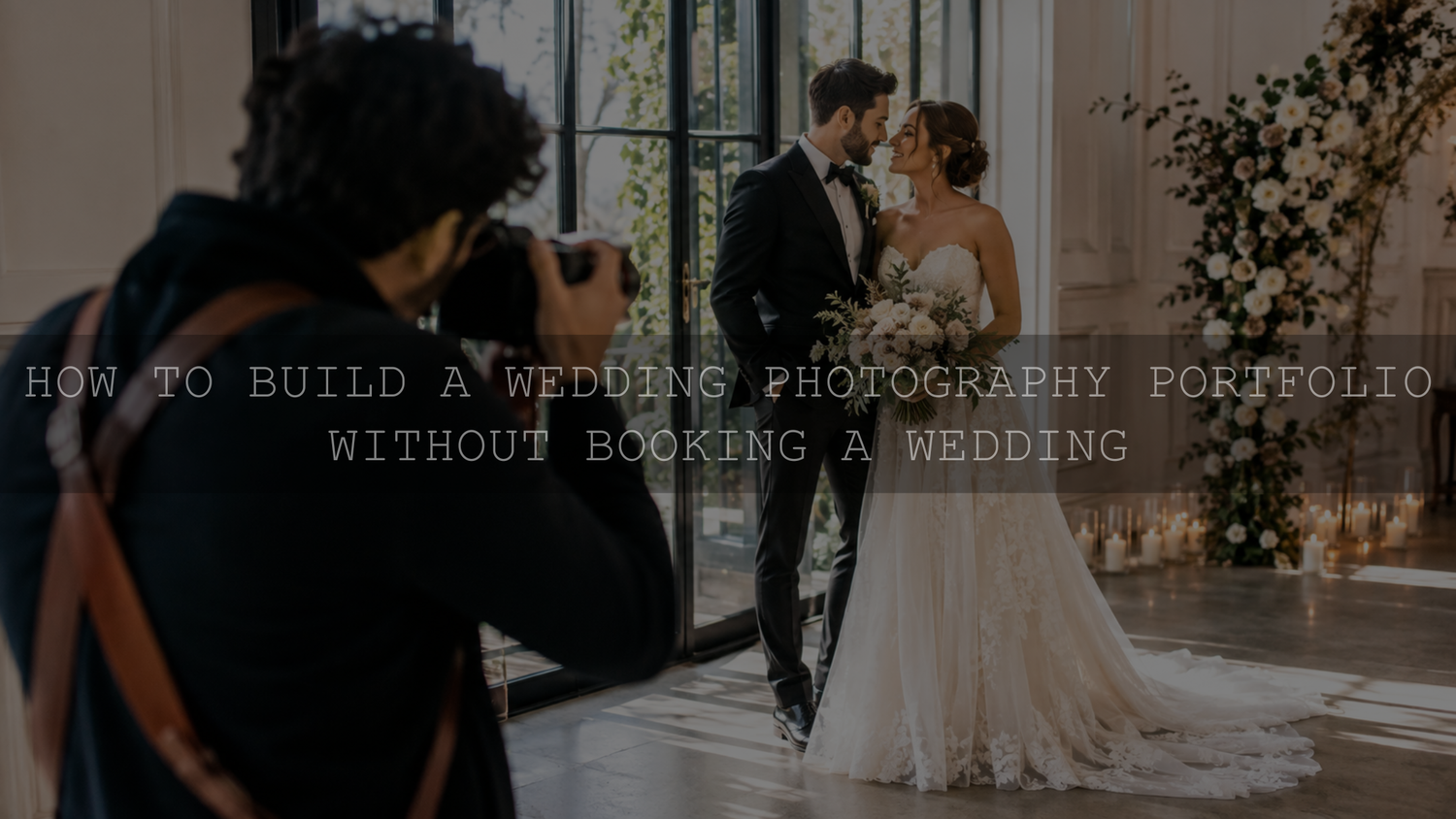
You can build a wedding photography portfolio before booking your first paid wedding, but the strongest approach is not to make one styled shoot look like a complete wedding career. Instead, build different kinds of evidence: controlled sessions that demonstrate your visual style, wedding-adjacent sessions that develop posing and storytelling skills, and real event experience that shows you can respond when the schedule, lighting and people are no longer under your control.
The goal is to prove more than your ability to make an attractive portrait. A useful wedding portfolio should gradually demonstrate couple direction, details, candid moments, group photographs, changing light, indoor scenes, low-light work and consistent editing. If you are also working on the wider business, see the guide to starting a photography business with no clients.
Build Your Wedding Portfolio in the Right Order
Think of portfolio building as a progression rather than a single shoot. Different projects prove different skills.
- Controlled visual proof: Use styled wedding shoots to develop your preferred colors, locations, wardrobe, posing, compositions and editing direction.
- Couple and editorial proof: Photograph engagement sessions, anniversary sessions, post-wedding portraits or clearly identified conceptual elopements to develop natural interaction and visual storytelling.
- Real event proof: Second shoot or assist at actual weddings where permitted. This introduces real timelines, ceremony restrictions, guests, unpredictable moments and rapidly changing light.
- Lead-photographer readiness: Move toward photographing a full wedding only when your technical ability, equipment plan, communication, file management and event experience are ready for the responsibility.
This distinction matters because a controlled editorial can demonstrate taste and technical skill without demonstrating that you can manage every part of an actual wedding. There is nothing wrong with styled work; it simply needs to be presented for what it is.
Plan Styled Shoots Around Portfolio Gaps
A styled shoot is most useful when it solves a specific portfolio problem. Before contacting vendors or choosing flowers, review what your existing work fails to demonstrate.
For example, if your portfolio already contains strong outdoor couple portraits, another sunset session may add very little. You may gain more from creating an indoor bridal-preparation scene, photographing formal groups, working with white clothing in bright conditions or practicing flash after dark.
Create a Wedding Coverage Matrix
Use a simple coverage checklist while planning. You do not need every category in a single shoot, but your eventual portfolio should show that your skills extend beyond close couple portraits.
- A wide establishing photograph showing the environment or venue.
- Wedding details such as attire, rings, stationery, florals or table styling.
- Individual bridal or groom portraits.
- Natural couple portraits at different distances.
- Movement such as walking, turning, entering a space or interacting.
- Small group photographs with deliberate positioning.
- Close emotional or observational frames.
- Backlit or high-contrast scenes.
- Indoor window light or another lower-light situation.
- Flash or reception-inspired photographs if that technique fits your intended service.
A mood board is useful for defining the visual direction, but a coverage matrix makes the session more valuable as evidence of photographic ability.
Approach Vendors With a Specific Proposal
Florists, bridal boutiques, makeup artists, planners, venues and other wedding businesses may be potential collaborators, but do not assume that they will provide products, services or locations for free. Send a concise proposal explaining the concept, planned date, participants, intended photographs, what you are requesting and what each collaborator would receive.
Before the shoot, put important expectations in writing. Agree on delivery, credits, image usage, deadlines and any restrictions. Obtain appropriate permission for recognizable people, private locations and other material you plan to use publicly.
Use Second Shooting to Learn What a Styled Shoot Cannot Teach
A real wedding moves independently of the photographer. Ceremonies begin, guests change position, weather shifts, speeches happen unexpectedly and important reactions may last only a few seconds. Second shooting can expose you to these conditions without immediately making you responsible for the entire wedding.
When approaching established wedding photographers, lead with reliability rather than claiming experience you do not have. A concise introduction can include your strongest portrait or couple work, the equipment you can operate confidently, your availability, location and the areas in which you want more event experience.
When you do get an opportunity, pay attention to skills that are difficult to reproduce during a styled session:
- Anticipating reactions instead of directing every photograph.
- Working around ceremony rules and restricted positions.
- Moving between wide scenes and small emotional moments.
- Photographing guests who are not models.
- Working efficiently during short portrait windows.
- Handling mixed indoor lighting and dark reception spaces.
- Staying aware of the lead photographer rather than duplicating the same angle.
- Maintaining concentration across a long event.
Confirm Portfolio Rights Before Publishing Anything
Do not assume that being the person who pressed the shutter automatically means you can publish second-shooter photographs wherever you want. Your agreement with the lead photographer may address image ownership, portfolio use, editing, posting dates, couple privacy, credits and other restrictions, while the applicable law can vary by location.
Confirm the terms before the wedding and keep them in writing. The Professional Photographers of America also provides guidance on photography contracts and usage rights. If your agreement does not allow portfolio use, respect it. The experience can still be valuable even when the photographs cannot be published.
Create Wedding-Adjacent Sessions Without Pretending They Were Weddings
Engagement sessions, anniversary portraits, post-wedding sessions and conceptual elopement shoots can all develop skills that transfer to weddings. Friends or couples you know can also be useful collaborators when everyone understands the purpose of the shoot and agrees to the intended image use.
The important part is presentation. A styled elopement should not be described as a real elopement you were hired to photograph. A formal portrait session should not be turned into a fictional client testimonial or invented wedding story.
Clear descriptions such as “styled wedding editorial,” “conceptual elopement session,” “engagement session” or “second-photographer coverage” allow the work to demonstrate your photography without creating a false impression about your experience.
Practice Difficult Wedding Lighting Deliberately
It is easy to build an attractive beginner portfolio entirely around golden hour. The problem is that weddings rarely stay in one type of light.
When you control a portfolio session, use that control to create useful challenges. Photograph part of the session in bright daylight, move indoors near a window, work in open shade, photograph white clothing against a bright background and finish after sunset if your intended wedding service includes evening coverage.
As your experience grows, your portfolio should give potential clients evidence that your style remains recognizable when the lighting changes rather than showing only the easiest conditions.
Edit for Consistency Without Making Every Photograph Identical
A wedding portfolio usually combines photographs made at different times, locations and color temperatures. Consistency therefore comes from repeatable editing decisions rather than forcing identical settings onto every file.
Decide how you normally want to handle contrast, warmth, saturation, black depth, skin tones and overall color. Then correct individual files according to their exposure, white balance and lighting. A preset can provide a useful starting direction, but the same preset can look noticeably different when the original photographs have different exposure, white balance, camera profiles or ambient light.
Wedding photographs also deserve special attention around skin tones, white dresses, dark suits and strong venue color casts. Review these elements after applying a preset instead of assuming the initial result is finished. For a broader framework, see how to create a consistent editing style for your portfolio.
Curate Evidence Instead of Collecting the Most Photographs
A portfolio does not become stronger simply because it contains more images. Every photograph should contribute something useful to the overall impression.
When reviewing your work, ask what each photograph demonstrates. One may show natural posing, another low-light control, another an emotional reaction and another the ability to compose a complex group. If ten photographs communicate essentially the same skill, keep the strongest examples rather than padding the gallery.
Try to create enough variety that a prospective wedding client can answer questions such as:
- Can this photographer make flattering couple portraits?
- Can they photograph details and the wider environment?
- Can they capture spontaneous moments?
- Does the editing remain coherent across different light?
- Can they work indoors as well as outdoors?
- Can they photograph more than one or two people?
- Does the work tell a sequence rather than showing only isolated hero images?
When you eventually have photographs from real weddings, sequences from the same event can demonstrate continuity more effectively than a portfolio made entirely from unrelated single images. Keep styled and real-event work accurately described so visitors understand what they are seeing.
Know the Difference Between Portfolio Readiness and Wedding Readiness
Having enough attractive photographs for a website does not automatically mean you are ready to accept responsibility for an entire wedding.
Before taking a lead role, consider whether you can reliably photograph changing conditions without constant experimentation, communicate with the couple, work around a timeline, manage formal groups, handle difficult light and protect the photographs after the event. You should also have realistic plans for critical equipment problems, batteries, memory cards and file backups.
If those parts are still unfamiliar, continuing to second shoot or photograph lower-risk sessions can be more useful than rushing into a wedding simply because you want additional portfolio images.
Prepare the Portfolio for Your Website
Once you have selected the strongest work, organize it around the type of weddings you want to photograph rather than every style you have ever tried. The first images should establish a clear visual direction, while the rest of the gallery should add useful evidence and variety.
Before uploading full-resolution camera files, prepare suitable website versions. The AAAPresets guide to preparing edited photographs for a portfolio website covers web-friendly sizing, color and export considerations.
Be equally careful with the words around your photographs. Accurate session descriptions, clear contact information and straightforward explanations of your current experience build more trust than trying to make a new portfolio appear larger or more established than it really is.
Common Wedding Portfolio Mistakes to Avoid
- Creating only golden-hour couple portraits and ignoring difficult lighting.
- Presenting a styled shoot as a real wedding.
- Publishing second-shooter photographs without confirming usage rights.
- Adding weaker images simply to make the portfolio look larger.
- Applying identical preset settings without correcting exposure or white balance.
- Showing several shoots with completely unrelated editing styles.
- Concentrating on details and portraits while showing no candid or wider storytelling work.
- Accepting a complex lead wedding before you can reliably handle the responsibilities behind the portfolio.
Using Wedding Presets While Developing Your Editing Style
If you want a broader set of starting points while developing your wedding-editing direction, the 150+ Gorgeous Lightroom Presets for Wedding Photography pack includes 150+ XMP preset items for Lightroom Desktop, Lightroom Classic and Adobe Camera Raw 10.3 or later on Mac and Windows, with RAW and JPEG support. Apply a look as a starting point and then refine exposure, white balance, highlights and other image-specific corrections rather than expecting one setting to fit every photograph. You can also browse the Wedding Lightroom Presets collection. The current AAAPresets offer is Buy 3, Get 9 FREE.
Frequently Asked Questions
Can styled wedding photos go in my portfolio?
Yes, provided you created the photographs, have the necessary permission to publish them and present the session accurately. Styled work can demonstrate your visual direction, posing, lighting and editing, but it should not be represented as a paid or real wedding if it was not one.
Can I use photographs I took as a wedding second shooter?
Only when your agreement and applicable usage rights allow it. Confirm portfolio use with the lead photographer before publishing anything, including requirements around editing, credits, posting dates or couple privacy.
How many photographs should a beginner wedding portfolio include?
There is no useful universal number. Include enough strong photographs to demonstrate the range of work you intend to sell without filling the portfolio with repetitive or weaker images simply to reach a target. As your real wedding experience grows, replace weaker early work with stronger and more representative coverage.
Do I need a complete wedding gallery before booking my first wedding?
A complete real-wedding gallery can provide stronger evidence of consistency across an entire event, but a new photographer may not have one immediately. Do not invent that experience. Build controlled portfolio work, gain real-event experience through second shooting where possible and move toward lead responsibility as your skills and workflow become reliable.
Final Takeaway
Building a wedding photography portfolio without clients is possible, but the objective should not be to make staged work look like years of wedding experience. Use styled shoots to establish your visual direction, couple sessions to improve communication and posing, and second shooting to learn the parts of a wedding that cannot be recreated reliably in a controlled session. Then curate the work honestly and replace early portfolio pieces as stronger real-event photographs become available.
Written by Asanka — creator of AAAPresets, serving more than 10,000 customers.

Leave a comment
This site is protected by hCaptcha and the hCaptcha Privacy Policy and Terms of Service apply.