
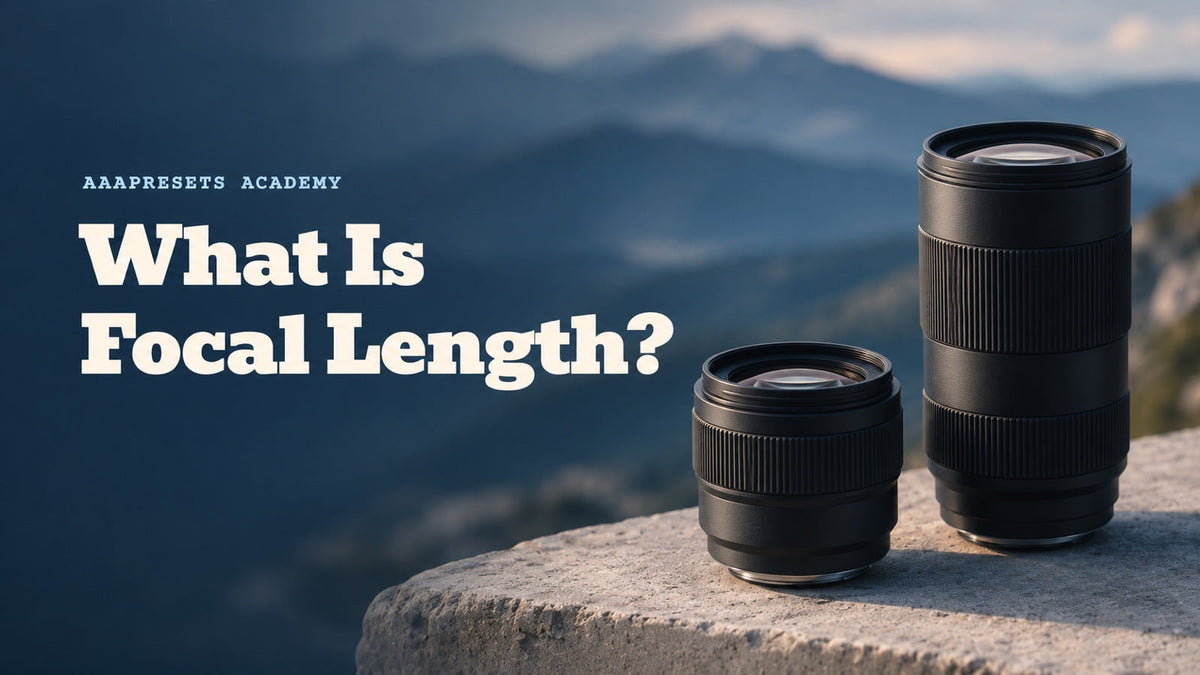
Focal length is a lens measurement, expressed in millimeters (mm), that helps determine how much of a scene appears in your photograph. On the same camera sensor, a short focal length such as 24mm captures a wider view, while a longer focal length such as 85mm frames a smaller part of the scene. Understanding those numbers helps you select a lens for portraits, travel, landscapes, and distant subjects without confusing focal length with aperture or shooting distance.
What Does Focal Length Mean on a Camera Lens?
Technically, focal length is an optical property measured with the lens focused at infinity. It is not simply the physical length of the lens barrel. For photographers, the most useful consequence is its relationship with angle of view: how much of the scene fits inside the frame.
For example, a lens labeled 24–70mm f/2.8 can change focal length from 24mm to 70mm. The f/2.8 marking refers to its maximum aperture, not its focal length. A 50mm f/1.8 lens has one fixed focal length, while the f/1.8 describes its maximum aperture. Sony's guide to lens basics illustrates how the angle of view changes as the focal length increases.
Focal Length Comparison: 16mm, 24mm, 35mm, 50mm, 85mm, 135mm, and 200mm
The following descriptions assume a full-frame camera. They are useful starting points, not fixed rules about which lens must be used for each subject:
- 16mm — ultra-wide: Captures an expansive scene, making it useful for architecture, interiors, dramatic landscapes, and large foreground elements. Keep important faces away from extreme close-up positions and frame edges.
- 24mm — wide-angle: Balances a prominent subject with plenty of surroundings. Useful for travel, documentary photography, landscapes, and environmental portraits.
- 35mm — moderate wide-angle: A practical storytelling perspective for street photography, everyday moments, small groups, and portraits that show a sense of place.
- 50mm — standard: A flexible choice for general photography, lifestyle portraits, food, and details without an extremely wide or tight view.
- 85mm — short telephoto: Offers tighter framing and a comfortable working distance for many individual portraits and headshots.
- 135mm — telephoto: Useful for isolating people, performances, and details when you can work farther from the subject.
- 200mm — telephoto: Helps frame distant action, wildlife, field sports, and selective landscape details. It also makes careful camera support and shutter-speed choices more important.
These focal lengths describe angle of view, not image quality. An 85mm lens can photograph a landscape, and a 24mm lens can create an expressive portrait. The right choice depends on what you want included in the photograph and where you can position the camera.
How Does Focal Length Change Framing?
Imagine photographing a person standing in a park while keeping your camera in exactly the same position. At 24mm, you might include the person, the path, nearby trees, and a large section of sky. At 50mm, the person occupies more of the frame. At 85mm, the composition gets tighter and includes less of the surrounding park.
The important point is that changing focal length from the same camera position changes framing, not the relative perspective of objects. If you crop the center of the 24mm photograph to match the 85mm framing, the relative proportions of objects remain the same, although the crop discards pixels and may not match the longer lens in detail or depth of field.
Does Focal Length Change Perspective or Facial Proportions?
This is one of the most misunderstood aspects of camera lenses. Focal length changes the angle of view, but camera position controls perspective—the relative apparent sizes of near and distant objects.
When someone takes a close-up selfie with a wide-angle lens, their nose may appear unusually large compared with their ears. The main reason is that the camera is very close to their face. To keep the same close-up framing with an 85mm lens, the photographer normally steps farther away. That greater shooting distance changes the facial proportions and can make the nose appear less exaggerated relative to the ears.
Likewise, the familiar look of a mountain appearing enormous behind a person often comes from photographing at a greater distance and using a longer focal length to fill the frame. The longer lens makes that distant composition practical, but the changed viewpoint produces the perspective relationship. Canon's illustration of photographic perspective demonstrates the visual effect.
There is also optical distortion, such as straight lines bending near the edges of an image. That is a separate issue related to lens design and should not be confused with perspective exaggeration.
Does a Longer Focal Length Make the Background Blurrier?
Often, but not automatically. At the same shooting distance and f-number, a longer focal length generally magnifies the subject more and produces shallower depth of field. For a similarly framed portrait, however, you usually move farther back with a longer lens. That changes the comparison.
With similar subject framing, the total depth of field may be more similar than people expect, even though the longer-lens photograph shows a narrower, often more magnified-looking background. Aperture, focus distance, and subject-to-background distance also affect the result. For a closer look at these variables, read our guide to how focal length affects depth of field.
Do not choose an 85mm or 200mm lens solely because you want blur. First decide how you want to frame the subject, how much room you have to work, and how much of the subject needs to remain sharp.
How Does Sensor Size Affect Focal Length and Field of View?
A smaller sensor records a narrower portion of the lens's projected image. The crop factor describes this field-of-view difference relative to full frame; it does not change the physical focal length printed on the lens. The lens also keeps its marked maximum f-number.
- 50mm on full frame: A standard 50mm view, used here as the reference.
- 50mm on a 1.5× APS-C camera: Approximately the same field of view as 75mm on full frame.
- 50mm on a 1.6× APS-C camera: Approximately an 80mm full-frame-equivalent field of view.
- 50mm on a 2× Micro Four Thirds camera: Approximately a 100mm full-frame-equivalent field of view.
For example, a 35mm lens on a 1.5× APS-C camera gives a field of view roughly equivalent to 52.5mm on full frame. That can be a useful everyday option when you want framing similar to a 50mm full-frame lens. To understand the wider trade-offs, see our full-frame vs. APS-C camera guide.
Remember that equivalent field of view does not mean two different sensor systems automatically produce identical depth of field or image quality.
Prime vs. Zoom Lenses: Which Should You Choose?
Prime lenses have one focal length, such as 35mm, 50mm, or 85mm. Some are relatively compact, and many offer wider maximum apertures than comparable zooms, which can help in low light or with shallow depth of field. They also encourage you to think carefully about where you stand.
Zoom lenses cover a range, such as 24–70mm or 70–200mm. They are convenient when the action moves quickly or when changing lenses would mean missing a moment. High-quality zooms can also be exceptionally sharp, so a prime is not automatically superior.
Choose based on working distance, maximum aperture, weight, cost, and what you photograph most often. A versatile zoom can be an excellent first lens; a prime is worth considering when a specific focal length or aperture solves a recurring need.
How to Choose the Right Focal Length for Your Photos
- Landscapes and interiors: Start around 16–35mm if you need a broad view. Be mindful of foreground exaggeration and lines near the frame edges.
- Travel and documentary scenes: Try 24–50mm for a balance between subject and surroundings.
- Environmental portraits: Try 24–35mm when the location matters as much as the person.
- Individual portraits and headshots: Try 50–135mm, depending on available space and the proportions you prefer.
- Sports, wildlife, and distant details: Consider 200mm or longer when you cannot move close enough, keeping in mind that adequate shutter speed and steady technique become increasingly important.
These ranges refer to full-frame fields of view. With a smaller sensor, account for crop factor before deciding how wide or tight your framing will be.
How to Check Which Focal Length You Actually Need
Before buying a new lens, review a selection of photographs you already like. If you shoot with a zoom, check the focal-length information saved in the image metadata. Notice whether your favorite portraits cluster around 50mm or 70mm, or whether your travel photographs repeatedly use the widest setting.
Then ask what limits the images you want to make: not enough space, subjects too far away, insufficient light, or simply a composition that needs a different viewpoint. If the problem is where you stand, a new focal length may not solve it. If you consistently need a view outside your zoom's range, another lens might be more useful.
Two Simple Focal Length Experiments
These two exercises isolate different variables. The first changes focal length while keeping your viewpoint fixed; the second changes your camera position to keep the subject similarly framed.
Experiment 1: Change the Lens Number, Not Your Position
- Choose a stationary subject with visible objects in the background.
- Keep the camera in the same spot and at the same height.
- Photograph the scene at 24mm, 35mm, 50mm, and 70mm if your zoom covers those settings.
- Compare how much of the scene fits into each frame. Notice that the underlying perspective is unchanged.
Experiment 2: Keep the Subject the Same Size
- Photograph a person at 35mm, leaving some background visible.
- Switch to 70mm and move backward until the person takes up about the same amount of the frame.
- Compare the relative size of the background objects and the person's facial proportions.
- Look at how changing shooting distance altered the perspective and how the narrower angle of view changed the composition.
Keep the lighting, subject pose, camera height, and aperture as consistent as practical. The goal is to understand what changed, not to declare one focal length the winner.
What Can You Change After Taking the Photo?
Cropping can create a tighter composition, but it discards image area and does not reproduce the new viewpoint you would get by physically changing camera position. Some lens-profile corrections can address optical distortion; they cannot reconstruct a different camera viewpoint or reveal scenery outside the captured frame. Editing also cannot reliably fix missed focus or severe motion blur.
Photo editing is more useful for refining color, white balance, exposure, highlights, and shadows. If you edit portraits in Lightroom, AAAPresets portrait Lightroom presets can provide a starting point for the finished color and tone. Adjust the look to suit the original lighting and skin tones rather than expecting a preset to change the lens perspective or recover missing detail.
The Key Focal Length Mistakes to Avoid
- Thinking higher millimeters always mean a better lens: Focal length describes framing, not overall optical quality.
- Thinking crop factor converts a 50mm lens into a different physical lens: It changes the recorded field of view.
- Blaming every stretched face on wide-angle optics: Close camera position is often the main cause of perspective exaggeration.
- Assuming telephoto automatically means creamy bokeh: Aperture, distances, and the background still matter.
- Choosing a focal length without considering available room: A long lens may be impractical indoors, while an extremely wide lens may make a tight headshot unflattering.
The Bottom Line
Focal length helps you decide how much of the world to include in your frame. Shorter focal lengths show more context; longer focal lengths isolate a smaller area. The look of the photograph also depends on where you stand, your sensor size, aperture, and the distances within the scene. Start with the story you want to tell, then choose a focal length and camera position that support it.
Written by Asanka Dilshan — founder of AAAPresets.


Leave a comment
This site is protected by hCaptcha and the hCaptcha Privacy Policy and Terms of Service apply.