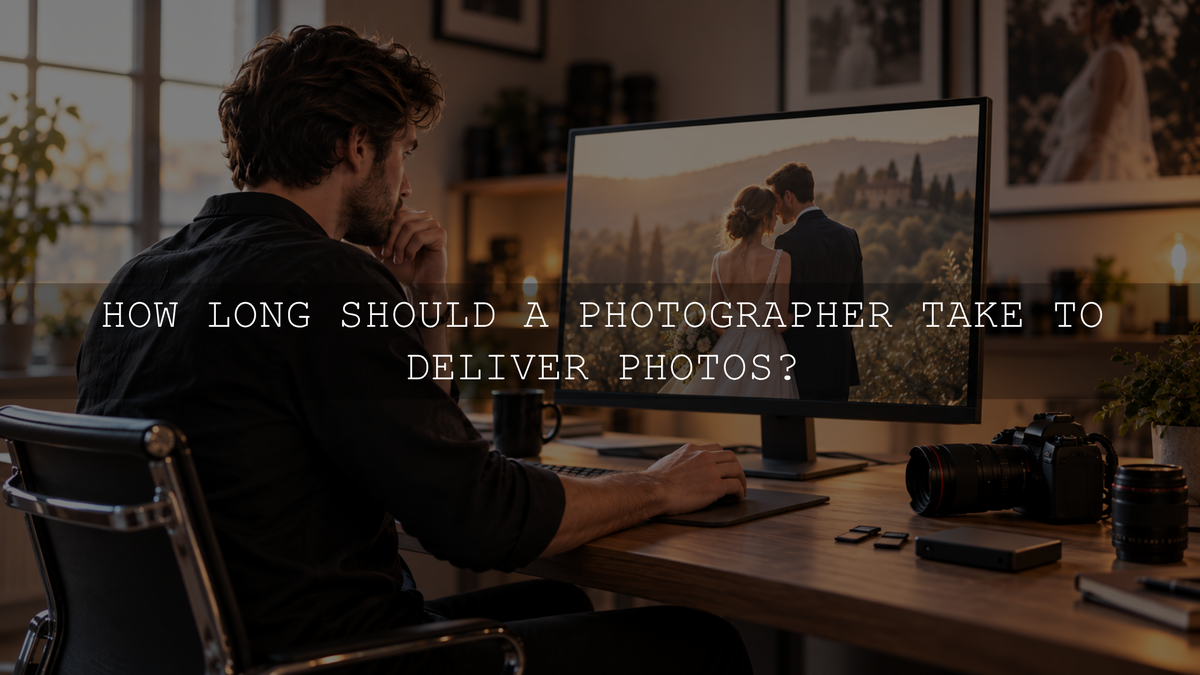
Photographers may take anywhere from a few business days to several weeks to deliver finished photos. There is no single turnaround time that applies to every portrait session, wedding, mini-session or commercial project.
The most important timeline is the one your photographer actually promised. Gallery size, editing and retouching requirements, client selections, approval rounds and the photographer's existing workload can all affect how quickly finished images are ready.
If you are waiting for your photos, rough examples can provide context, but they should not replace the delivery window written into your booking confirmation, proposal or agreement.
How Long Does It Usually Take to Get Photos Back?
Published turnaround times vary considerably between photographers and types of work. For example, Miller D Photography currently lists portrait delivery within 2 to 3 weeks and wedding-gallery delivery within 6 to 8 weeks. That is one photographer's workflow, not a universal industry standard.
Commercial and branding workflows can operate differently. Photography & Branding currently describes a soft-edited gallery delivered within 4 to 5 business days, followed by final edited images within another 3 to 4 business days after the client confirms selections.
Those examples show why it is more useful to think in terms of workflow than to search for one supposedly normal number. A practical rough guide is:
- Portrait and family photography: Often measured in weeks rather than days, although individual photographers may offer shorter or longer windows.
- Wedding photography: Full galleries can take several weeks because the photographer may be processing a much larger set of images from a long event.
- Branding and headshot sessions: Some studios work in stages, delivering proofs first and final retouched selections later.
- Commercial and product photography: Turnaround may be measured in business days for tightly defined projects, but complex retouching, approvals and large shot lists can extend the schedule.
- Mini-sessions: A smaller shooting window can mean fewer files to process, but the photographer may photograph many clients on the same day, so a short session does not automatically guarantee immediate delivery.
Always check whether the photographer means calendar days, business days or a particular number of weeks. Also confirm when that period begins. For some workflows it starts on the shoot date; for others it may begin after the client selects proofs, approves a shot list or completes another required step.
Why Photo Delivery Times Vary
The number of photographs captured and delivered
A photographer may capture many more frames than the number ultimately delivered. Similar expressions, missed focus, test frames, duplicates and weaker compositions normally have to be reviewed before the photographer can concentrate on the strongest photographs.
The number of finished images also matters. Editing 30 selected portraits is a different workload from preparing hundreds of wedding photographs. If you are planning your own packages, our guide to how many edited photos a photographer should deliver explains why gallery size should be based on the service rather than an arbitrary image count.
The amount of editing included
"Edited photos" can describe very different levels of work. One photographer may include exposure, white balance, color, crop and basic tonal adjustments. Another package may include detailed skin retouching, object removal, compositing or other image-specific work.
That distinction matters because batch adjustments only go so far. Images photographed under similar conditions may share a starting point, but exposure, white balance, mixed lighting, skin tones, highlights, shadows and local corrections can still require individual review.
Proofing and client selections
Some photographers choose the final gallery themselves. Others send a proof gallery and wait for the client to select the images that will receive detailed retouching. In the second workflow, the final delivery date can depend partly on how quickly the client submits those selections.
This is why a promise such as "final images within five business days of receiving your selections" means something different from "gallery delivered within five business days of the shoot."
Approval rounds and commercial requirements
Commercial projects may involve an art director, agency, marketing team or business owner reviewing photographs before final delivery. Changes to crops, retouching, product colors, file dimensions or other agreed specifications can add another stage to the workflow.
Existing workload and scheduling
A photographer's turnaround should account for work that was booked before your session. Busy periods can increase the queue, but a professional delivery estimate should ideally already allow for the photographer's normal workload rather than relying on the client to guess how busy the studio is.
Albums and prints may follow a separate schedule
Digital-gallery delivery and physical-product delivery should not automatically be treated as the same deadline. Albums, wall art and prints may require image selection, design approval, printing and shipping after the digital photographs have been completed.
What Happens After a Photoshoot?
The camera portion of the job is only one stage of producing a finished gallery. A typical post-production workflow can include:
- File verification and backup: The photographer checks that the captured files have transferred correctly and creates the working copies required by their backup workflow.
- Culling: The photographs are reviewed so duplicates, missed moments and technically unsuitable frames can be separated from stronger candidates.
- Base corrections: Exposure, white balance, tonal balance, lens-related corrections and crops may be adjusted before the final look is refined.
- Creative editing: Color treatment, contrast and overall style are developed consistently across the gallery. Presets can provide a useful starting point, but they do not remove the need to evaluate individual photographs.
- Individual refinement: Images that need additional skin-tone correction, highlight recovery, mixed-light adjustment, masking or retouching receive more targeted attention.
- Quality control: The photographer reviews consistency, crops, distractions and other visible problems before final export.
- Export and delivery: Finished files are exported to the required sizes or formats and uploaded to the agreed gallery or delivery system.
Adobe's Camera Raw documentation explains that camera raw files preserve unprocessed image data and provide greater control over processing than camera-processed JPEG files. That generally gives photographers more flexibility for substantial exposure, white-balance and tonal adjustments, but it does not make every photograph identical. Camera profile, lighting, subject colors and the original exposure can all affect how the same editing approach looks from one photograph to another.
For photographers who want a broad starting library for Lightroom editing, the 1000+ Master Lightroom Presets Bundle currently includes 1000+ DNG preset files for Lightroom Mobile and 1000+ XMP preset files for Lightroom Desktop. Its product page currently lists compatibility with Lightroom Classic, Lightroom desktop and Lightroom Mobile. A preset can establish a starting look across a gallery, but photographs should still be checked individually for exposure, white balance, skin tones and other image-specific adjustments.
Is Same-Day Photo Delivery Realistic?
Same-day delivery is possible, but it should be treated as a specific service or workflow rather than the default expectation for professional photography.
A photographer might deliver a small set of event highlights on the same day, prepare a limited number of headshots on site or build a production workflow specifically around rapid delivery. That does not mean a complete wedding or extensively retouched commercial gallery can automatically follow the same schedule.
Faster delivery may require a smaller deliverable, dedicated editing time, additional staff or a rush fee. Photographers who offer expedited processing should define exactly what is included and price the additional workload deliberately. Our guide to pricing photography add-ons provides a framework for handling optional services without making the core package confusing.
What About Sneak Peeks?
A sneak peek and a completed gallery are separate deliverables. Some photographers provide a few early photographs after the session or wedding, while others do not include previews at all.
Not receiving a sneak peek is therefore not automatically a warning sign. It becomes relevant only when previews were explicitly included in the package or the photographer gave you a specific date for them.
Likewise, receiving five early images does not necessarily mean the remaining gallery is almost complete. The photographer may intentionally edit a small preview set before returning to the larger culling and editing workflow.
When Should You Follow Up With a Photographer?
Start with the written delivery expectation. Check your contract, booking confirmation, proposal or email thread for the promised date or turnaround window.
If you are still comfortably inside that period, there is usually no need to assume something is wrong. If you have a genuine deadline that was not discussed previously, you can still ask whether earlier delivery is possible, but the photographer may not be able to change the original schedule.
If the promised deadline has passed without an update, a brief and specific follow-up is reasonable. For example: "Hi, I am checking on the gallery from our May 10 session. Our agreement listed delivery within three weeks. Could you let me know the current expected delivery date?"
If the photographer communicates a delay, ask for a concrete revised date rather than repeatedly checking for general progress. Repeated missed dates combined with a lack of response are more significant than simply waiting a long time that was clearly agreed before booking.
The Professional Photographers of America recommends being specific about deliverables in photography contracts, including what the client receives and when those deliverables are expected. Its photography contract guidance also recommends defining details such as galleries, downloads, proofing rounds, retouching and physical products when those are part of the package.
If a serious contractual dispute develops, the appropriate next step can depend on the agreement, payment method and laws where you live. General photography advice cannot determine your legal rights in a specific dispute.
What Should You Ask Before Booking?
You can remove most delivery uncertainty before the photoshoot by confirming a few details:
- What is the expected turnaround for the full gallery?
- Is the estimate stated in calendar days, business days or weeks?
- When does the turnaround period officially begin?
- Approximately how many finished photographs are included?
- Does the photographer select the final images, or will you choose from proofs?
- What level of editing or retouching is included?
- Are sneak peeks included, and if so, when are they expected?
- Is rush delivery available, and what exactly does it include?
- Are albums and prints subject to a separate production schedule?
- How will the photographer communicate if the expected deadline changes?
These are useful details to cover during a photography client consultation rather than trying to resolve them after the shoot.
For Photographers: Set a Turnaround You Can Actually Keep
A competitive turnaround is not necessarily the shortest turnaround. It is one you can deliver consistently while maintaining the scope and quality promised to the client.
Measure the complete workflow rather than estimating only active editing time. Account for file management, culling, editing, retouching, client selections, quality control, export and delivery. If your workflow depends on the client approving proofs, state clearly that the final-delivery period begins after those selections are received.
It is also sensible to build reasonable capacity into the schedule rather than promising your fastest-ever turnaround on every booking. When you know a deadline may be missed, communicating before the promised date is more useful to the client than waiting until they ask where their photographs are.
Do not copy another photographer's turnaround simply because it sounds competitive. Their gallery size, retouching scope, staffing, automation, outsourcing, client volume and business model may be completely different from yours.
The Promised Delivery Window Matters Most
There is no universal answer to how long photographers take to deliver photos. Portrait galleries may take a couple of weeks in one studio, wedding galleries may take several weeks, and tightly defined branding projects may move through proofing and final delivery in only a few business days.
The useful question is not whether your photographer matches somebody else's timeline. It is whether the scope and delivery date were explained clearly and whether the photographer is meeting the commitment they made to you.
Before booking, confirm the delivery window and what starts the clock. After the shoot, use that written expectation as your reference point. For photographers, a realistic and clearly documented turnaround is usually more valuable than promising the fastest possible delivery.
Written by Asanka — creator of AAAPresets, serving more than 10,000 customers.



Leave a comment
This site is protected by hCaptcha and the hCaptcha Privacy Policy and Terms of Service apply.