




A standard lens, also called a normal lens, provides a moderate angle of view that feels natural for many everyday photographs. On a full-frame camera, 50mm is the classic example. On smaller sensors, a shorter focal length produces a comparable view. Standard lenses are useful for street photography, portraits, travel, and daily life, but they are not automatically the best choice for every subject.
What Makes a Lens a Standard Lens?
Lens categories describe angle of view: how much of a scene fits into a photograph. A standard lens sits between a wide-angle lens, which includes more of the surroundings, and a telephoto lens, which shows a narrower portion of the scene.
One traditional reference point is a focal length close to the camera sensor's diagonal measurement. A full-frame sensor measures approximately 43mm diagonally, making focal lengths around 40mm to 50mm natural candidates. The familiar 50mm lens became a common standard option, but it is not the only one.
The label is about field of view, not price, optical quality, maximum aperture, or whether the lens can zoom. Nikon's guide to focal length explains how focal length affects framing and magnification.
What Focal Length Is Standard on Different Cameras?
A standard field of view depends on sensor size. These are useful starting points rather than strict boundaries:
- Full-frame: Around 40mm to 50mm is commonly considered normal, with 50mm the classic choice.
- APS-C: Approximately 30mm to 35mm gives a familiar standard view on many cameras. The exact match depends on whether the system uses roughly a 1.5x or 1.6x crop factor.
- Micro Four Thirds: Around 25mm provides a field of view similar to 50mm on full frame.
For example, 35mm on a camera with a 1.5x crop factor provides approximately the same angle of view as 52.5mm on full frame. The physical lens remains 35mm; the smaller sensor records a narrower portion of the image projected by it. A 50mm lens on that same APS-C camera gives a tighter view, similar to 75mm on full frame. For a deeper explanation of crop factors, see our guide to how sensor size changes your photos.
Is a Standard Lens the Same as a Prime Lens?
No. A prime lens has one fixed focal length, while a zoom lens offers a range of focal lengths. Either can give a standard angle of view.
A 50mm f/1.8 prime is one example. A 24-70mm zoom on a full-frame camera also provides a standard view when set near 50mm. The prime may offer a wider maximum aperture and a simpler carrying setup, depending on the model. The zoom offers the flexibility to switch to wider or tighter framing without changing lenses.
This distinction matters when deciding what to buy: if you already own a zoom that covers 50mm, you can learn standard-lens composition before purchasing a separate prime.
Does a 50mm Lens See Exactly Like the Human Eye?
Not exactly. Human vision is binocular, changes with attention, and covers a much more complex field than one rectangular camera frame. Calling 50mm "natural-looking" is a useful photography convention, not a precise measurement of human eyesight.
It is also important to separate perspective from field of view. Camera position determines the relative apparent sizes of near and far objects. Focal length changes how much of that scene is included. If you photograph a person from one position at 35mm and 50mm, the 50mm frame is tighter, but the relative geometry remains the same. If you move backward with the 50mm lens to keep the person the same size, the changed camera position creates a different perspective. Canon's perspective explainer illustrates the visual effects.
A standard lens does not eliminate optical distortion, either. Barrel or pincushion distortion depends on lens design, and an unflattering close-up can still result from placing the camera too near someone's face.
Standard Lens vs. Wide-Angle and Telephoto Lenses
On a full-frame camera, these focal lengths serve different compositions:
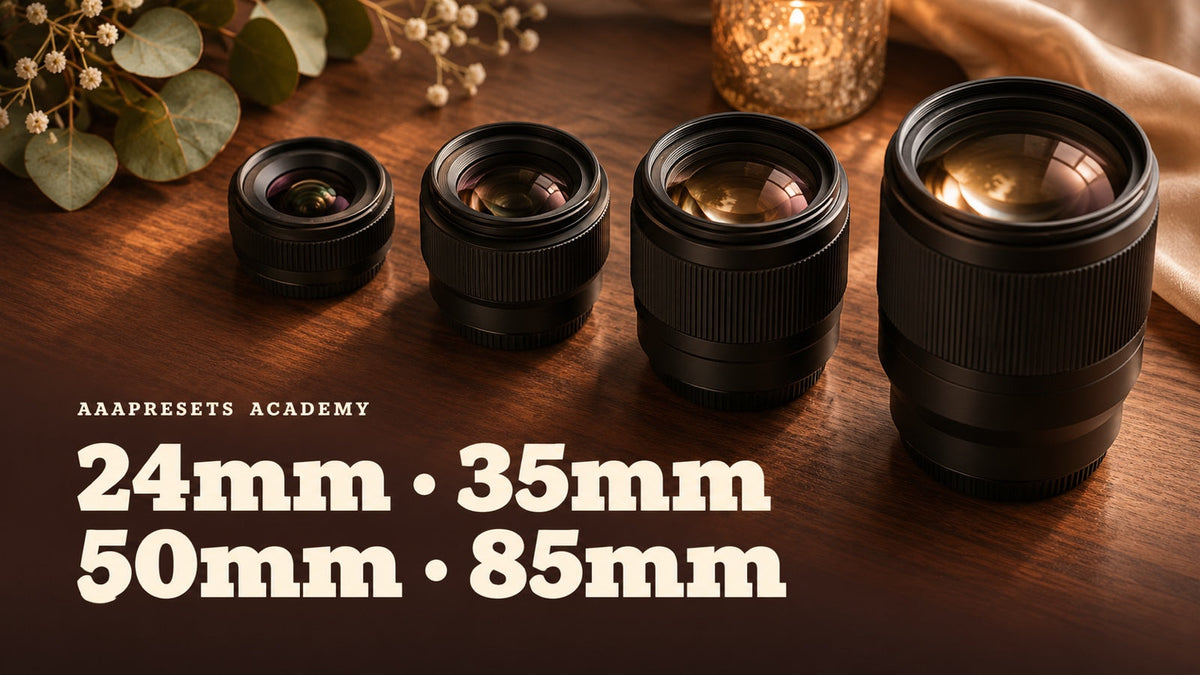
- 35mm: A moderately wide view that gives more space for people and their surroundings, especially in smaller rooms or busy streets.
- 50mm: A balanced view that can isolate a subject while retaining a useful amount of context.
- 85mm: A tighter view that is often convenient for individual portraits when there is enough room to stand farther back.
None is universally more professional. Choose according to the space you have, the distance you want to work from, and how much of the environment belongs in the photograph.
When Is a Standard Lens Most Useful?
- Street and documentary photography: Capture a person, gesture, or small moment without including the entire street in every frame.
- Environmental portraits: Photograph someone in a café, studio, or workplace while preserving enough surroundings to explain the setting.
- Travel and everyday moments: Work with one versatile field of view and spend more attention on timing and composition.
- Food and larger products: Record appealing details at a comfortable distance, provided the lens focuses closely enough for the shot.
There are real limitations. A 50mm lens on full frame may be too tight for a cramped interior or a large group. Distant wildlife and field sports often benefit from longer lenses. Tiny products and insects may require a dedicated macro lens for the magnification needed.
How to Get Better Photos With a Standard Lens
- Choose the camera position first. Decide whether the background should feel close, distant, busy, or quiet. Do not treat stepping forward as identical to zooming in.
- Set aperture for the subject. Try f/1.8 to f/2.8 for a single portrait when shallow depth of field suits the image. Use f/4 to f/8 as starting points when more of a group, product, or scene needs to stay sharp. Your lens may not offer every value.
- Watch shutter speed. For a handheld 50mm photo of a relatively still person, 1/125 second can be a practical starting point. Try around 1/250 second or faster for casual movement, and adjust to the actual action and lighting. Stabilization cannot freeze a moving subject.
- Check focus and edges. Confirm that the important eye or detail is sharp and that unwanted objects are not entering the frame. A wide aperture makes focus errors easier to notice.
- Work with subject-to-background distance. Move your subject farther from a distracting wall when you want more separation. The background's appearance depends on more than aperture alone.
For more detail on these creative choices, explore how focal length changes depth of field and what happens when you shoot a lens wide open.
Try This Simple Standard-Lens Exercise
This practice separates framing from perspective without needing special equipment:
- Use a 50mm lens on full frame, a suitable crop-sensor equivalent, or set a zoom to its normal focal length. Photograph a person or stationary object with some background visible.
- Without changing focal length, take another photograph from a different distance. Notice how the apparent relationship between subject and background changes.
- If you have a zoom, return to the first camera position and compare frames at a wider and a longer setting. Notice how the frame changes while the relationships between objects stay consistent.
- Take one additional frame with a different aperture and compare how much of the subject and background remains acceptably sharp.
The goal is not to declare one frame the winner. It is to recognize when a change comes from your position, focal length, or aperture so you can choose deliberately in future photographs.
Editing Photographs Taken With a Standard Lens
A balanced field of view does not guarantee balanced exposure or color. In Lightroom, begin by reviewing white balance, exposure, highlights, and shadows. Mixed indoor lighting may need additional color correction, while outdoor portraits may benefit from careful skin-tone adjustments. Adobe's Lightroom light-and-color tutorial explains the main controls.
If you apply an editing preset, treat it as a starting point. The same color settings can look different on RAW and JPEG files or on photographs taken under different lighting. Check the result and refine it instead of assuming one preset will suit every scene. Editing can improve the presentation of an image, but it cannot substitute for thoughtful camera position or reliably recover missed focus.
Should You Choose a Standard Lens?
Choose a standard lens if you want a practical field of view for people, places, and everyday stories. A 50mm prime can be an excellent compact option, but a zoom covering the normal range works just as well for learning composition. If your photography mostly involves very tight spaces, distant subjects, or extreme close-ups, another focal length or a specialist lens may serve you better.
Written by Asanka — creator of AAAPresets.


Leave a comment
This site is protected by hCaptcha and the hCaptcha Privacy Policy and Terms of Service apply.