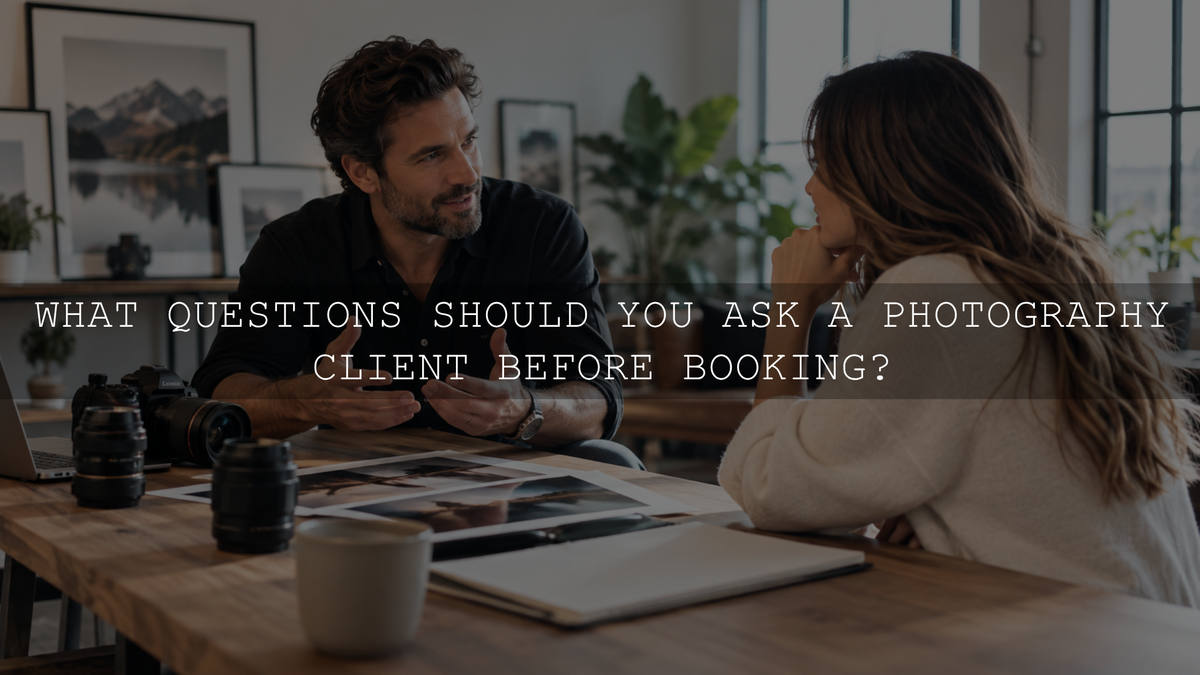
A useful pre-booking photography questionnaire should help you answer a few practical questions: Can you take the assignment? Are you available? What is the real scope of the work? What does the client expect to receive? What information do you need before you can quote or recommend the next step?
You do not need to collect every shoot-day detail before a prospective client has even decided whether to hire you. Keep the first inquiry relatively easy to complete, collect the details that affect the booking decision, and move detailed planning questions into the post-booking workflow.
Questions to Ask Photography Clients Before Booking
The exact questions depend on the type of photography, but the following 12 questions cover information that commonly affects availability, scope, pricing and expectations. If your service is still broad, first define your ideal photography client so your inquiry process reflects the work you actually want to book.
- What type of photography do you need? Start by identifying the service rather than assuming that a request for “photos” describes the assignment. A family portrait, wedding, product shoot, corporate headshot session and advertising campaign can require very different planning, equipment, deliverables and agreements.
- What date or timeframe are you considering? For an event, you may need one fixed date and coverage window. Portrait clients may have several suitable dates. Commercial clients may instead have a campaign deadline with some flexibility around the production day. Do not promise availability until you have enough information to check the correct period.
- Where will the photography take place? Ask for the city, venue or proposed location when it affects availability, travel, access or pricing. A project involving several locations should identify that early because travel between them can affect the amount of usable shooting time.
- What is the main purpose of the photographs? The answer helps define what you actually need to create. A family may want photographs for albums and wall prints, while a company may need website banners, product pages, advertisements and social media assets. The intended outcome is usually more useful than asking only what visual style the client likes.
- Who or what needs to be photographed? Establish the approximate number of people, products, properties, locations or setups involved. Scope can change significantly between one portrait and a large family group, or between photographing five products and photographing fifty products with multiple angles.
- What finished deliverables do you need? Find out whether the client expects a finished gallery, a defined number of final images, prints, albums, individually retouched hero photographs, several crops or orientations, or another specific output. Do not assume that vague terms such as “the photos” or “high resolution” mean the same thing to both parties.
- What visual direction are you looking for? Ask what attracted the client to your portfolio and invite them to share a small number of references when useful. Terms such as candid, editorial, natural, dramatic, bright or cinematic can help begin the discussion, but reference images should communicate direction rather than become an obligation to reproduce another photographer's exact image.
- Are there important requirements or restrictions I should know before quoting? Examples could include restricted venue access, a fixed event schedule, required product angles, accessibility requirements, a limited setup period, confidentiality requirements or a location that needs special permission. Ask only for information genuinely relevant to providing the service.
- When do you need the finished photographs? A hard campaign launch, publication date or announcement may materially affect the project. If the requested deadline requires rush editing or cannot be met reliably, it is better to identify that before the booking is accepted.
- How will the photographs be used? This question is especially important for commercial work. A personal portrait gallery and photographs used in a national advertising campaign are not the same usage requirement. For business assignments, clarify the intended media before finalizing the quote and agreement.
- Does your budget or expected investment fit the service? You do not always need to ask for a maximum budget. If you sell fixed portrait packages, sending clear pricing and asking which package best fits the client's needs may be enough. For a custom commercial production, a realistic budget range can help determine whether the proposed scope and available resources are compatible.
- Who will approve the booking and final scope? This matters most when a company, agency or larger team is involved. The person sending the inquiry may not be the person who approves the budget, creative brief or final images. Knowing the approval process early can help identify potential scope changes before the project is confirmed.
Do Not Put Every Question on the First Inquiry Form
One of the easiest ways to improve a photography questionnaire is to stop treating the entire client journey as a single form. Information becomes useful at different stages.
Initial Inquiry
The initial contact form should normally collect enough information for you to understand the opportunity and respond intelligently. Depending on your service, that may be:
- Name and contact details.
- Type of photography required.
- Date or approximate timeframe.
- General location.
- A short description of what the client needs.
- One open field for important additional information.
If your packages and prices are already clearly published, the client may not need to answer much more before you reply. If you are still building the wider path from inquiry to paid work, the AAAPresets guide to getting your first five photography clients explains how inquiries, pricing, written terms and booking fit into a practical client-acquisition process.
Pre-Booking Qualification
Once you know that the inquiry is potentially suitable, collect the information that changes the scope or quotation. This is where you can discuss the number of people or products, coverage time, locations, required deliverables, style, deadlines, travel, commercial usage and other project-specific requirements.
The objective is not to interrogate the prospective client. It is to eliminate important unknowns before either side commits to something the other side did not intend.
Post-Booking Planning
After the client has accepted the service and completed your normal booking process, you can collect detailed production information. Depending on the assignment, that might include:
- A detailed event timeline.
- Family group combinations or important relationships.
- Participant names when useful for the session.
- Wardrobe, styling or prop information.
- Detailed shot priorities.
- Venue access instructions and parking information.
- On-site contact details.
- Product lists or final commercial shot lists.
- Accessibility or other practical accommodations the client wants you to know about.
- Final weather or location contingency arrangements.
Collecting this information closer to the shoot can also be more accurate because plans that were uncertain during the original inquiry may be finalized by then.
Use Different Questions for Different Photography Clients
A universal questionnaire can provide a useful foundation, but it should not force a wedding couple, portrait client and advertising agency through identical questions.
Portrait and Family Photography
For portraits and families, useful pre-booking questions can include:
- What type of session are you planning?
- Who will be photographed?
- What date or timeframe works for you?
- Do you already have a location in mind?
- What would you most like the finished photographs to capture?
- Do you prefer more guided portraits, more candid photographs or a mixture?
- Are there practical requirements or accommodations that would help the session run comfortably?
- Are you looking primarily for digital photographs, prints, albums or another finished product?
Do not require clients to disclose personal information that is unnecessary for delivering the service. When a comfort, mobility or accessibility question could be useful, make it easy for the person to share only what they want you to know.
Wedding and Event Photography
Before quoting a wedding or event, you may need to know:
- The event date.
- The venue or venues.
- The approximate coverage period.
- Whether significant parts of the event happen at different locations.
- The approximate event size when it affects the assignment.
- The main moments or portions of the event the client expects covered.
- Whether an engagement session, second photographer, album or other major service is required.
- Any schedule or access restriction that affects coverage.
A detailed family formal list normally does not need to be completed before a couple has booked you. That information is generally more useful during the later planning stage when the guest list and event schedule are more stable.
Commercial and Brand Photography
Commercial inquiries usually need more precise scoping because image usage and production requirements can materially change the project. Ask about:
- The business objective or campaign.
- The number of products, people, locations or setups.
- The required final image count or asset list.
- Required horizontal, vertical, square or other compositions.
- Retouching or post-production requirements.
- The final delivery deadline.
- Where the photographs will appear.
- Whether paid advertising is included.
- The proposed duration and geographic territory of the use when relevant.
- Whether exclusivity is requested.
- Which client entities need permission to use the photographs.
- Who approves the creative brief and final deliverables.
For U.S.-specific copyright background, the U.S. Copyright Office's guidance for photographers explains that the person who takes a photograph is generally its author and initial copyright owner, subject to exceptions such as qualifying works made for hire. Copyright and licensing rules differ internationally, so agreements should be appropriate for the law that applies to the assignment.
Questions That Sound Useful but Often Need Rewriting
Instead of Asking the Client to Evaluate the Lighting
A client may not know whether a room has enough usable light, what color temperature its fixtures produce or whether a photographer needs flash. Ask for the venue or location, access restrictions and the relevant schedule. The photographer can then investigate the technical requirements.
Instead of Asking How They Handle Stress
Questions about a person's general response to stress are unlikely to be necessary for most photography bookings. Ask about the practical issue instead. For example: Is the schedule fixed? Are there portions of the event that cannot run late? Is there anything about the photography process that would make the session more comfortable?
Instead of Asking for a Long List of Photographs to Copy
Reference images can reveal preferences for lighting, composition, posing, color or overall mood. Use them as communication tools rather than treating a Pinterest board as a production checklist that must be duplicated frame by frame.
Instead of Automatically Asking for a Maximum Budget
If a family session has three published packages, the useful question may simply be which package they are considering. If a company asks for an undefined custom campaign, discussing an approximate production budget can be much more valuable because scope can be adjusted around real requirements.
Turn Questionnaire Answers Into a Clear Quote and Agreement
A questionnaire collects information. It does not replace an agreement.
Before confirming the assignment, the final documents should accurately describe the service both parties have agreed to. Depending on the project, that can include:
- Date, time and location.
- Coverage or production scope.
- Finished deliverables.
- Editing and retouching included.
- Delivery timeframe.
- Price and payment schedule.
- Travel, permits or other agreed expenses.
- Cancellation and rescheduling terms.
- Commercial image usage where applicable.
- Responsibilities for access, locations and permissions.
- A process for approving changes to the scope.
Professional Photographers of America provides photography contract and release resources for several types of assignments, including portrait, wedding and commercial photography. Some downloadable resources may require PPA member access. Legal requirements vary by jurisdiction and assignment, so important contract, payment, cancellation and licensing language should be reviewed by an appropriately qualified professional for the place where you operate.
A Simple Pre-Booking Photography Questionnaire
If you want a short starting template, adapt the following questions to the service you actually sell:
- What type of photography are you looking for?
- What date or timeframe are you considering?
- Where will the photography take place?
- What is the main purpose of the photographs?
- Who or what needs to be photographed?
- What finished photographs, products or other deliverables do you need?
- What attracted you to my work, and do you have any useful visual references?
- Are there deadlines, access restrictions or other requirements that could affect the assignment?
- If this is commercial photography, where and how do you expect the finished images to be used?
- Have you reviewed the relevant pricing, or is this a custom project that requires a quotation?
- Is there anything else that would materially affect the scope or help me recommend the correct next step?
Then remove questions that do not apply and add only the service-specific questions that influence your decision or quotation. Conditional forms can be particularly useful: a portrait client does not need to read licensing questions intended for an advertising agency, while a commercial client should not have to answer wedding-planning questions.
Ask Enough to Make the Next Decision
The best pre-booking questionnaire is not necessarily the longest one. Ask enough to understand the service, date, location, scope, deliverables, creative direction, deadline, price and relevant image usage. Use those answers to decide whether the project fits, prepare the correct quotation and explain the next step.
Once the booking is confirmed, move into a more detailed planning questionnaire that collects the information needed to execute the shoot. Keeping qualification and production planning separate makes the process easier for the client while still giving the photographer the information needed at the point when it becomes useful.
Written by Asanka — creator of AAAPresets, serving more than 10,000 customers.

Leave a comment
This site is protected by hCaptcha and the hCaptcha Privacy Policy and Terms of Service apply.