
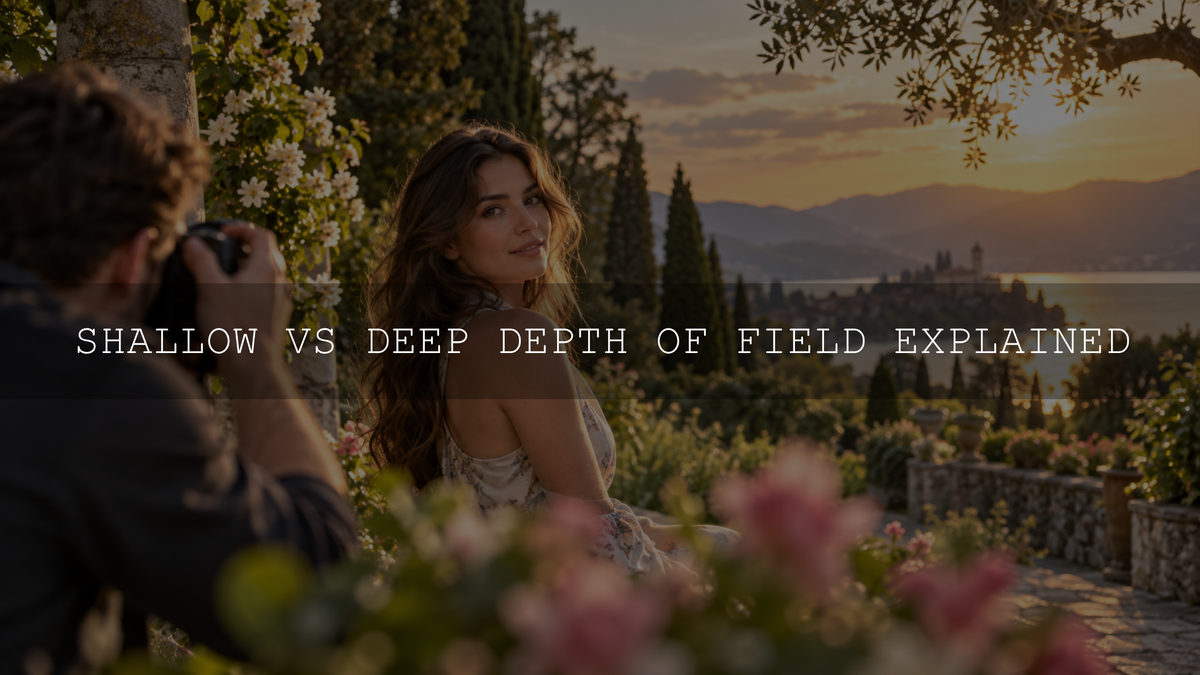
Shallow depth of field keeps only a relatively narrow range of a photograph acceptably sharp, often separating a subject from a soft foreground or background. Deep depth of field keeps a much larger range of the scene acceptably sharp, making it useful when foreground, subject and background details all matter.
Neither approach is automatically better. The right choice depends on what you want the viewer to notice. Portrait photographers may use shallow depth of field to isolate a face, while landscape or architectural photographers often need greater depth so important details remain clear from near to far.
Aperture strongly influences depth of field, but it is not the only control. Focal length, focusing distance, framing, subject-to-background distance and camera format can all change the final appearance.
What Is Depth of Field?
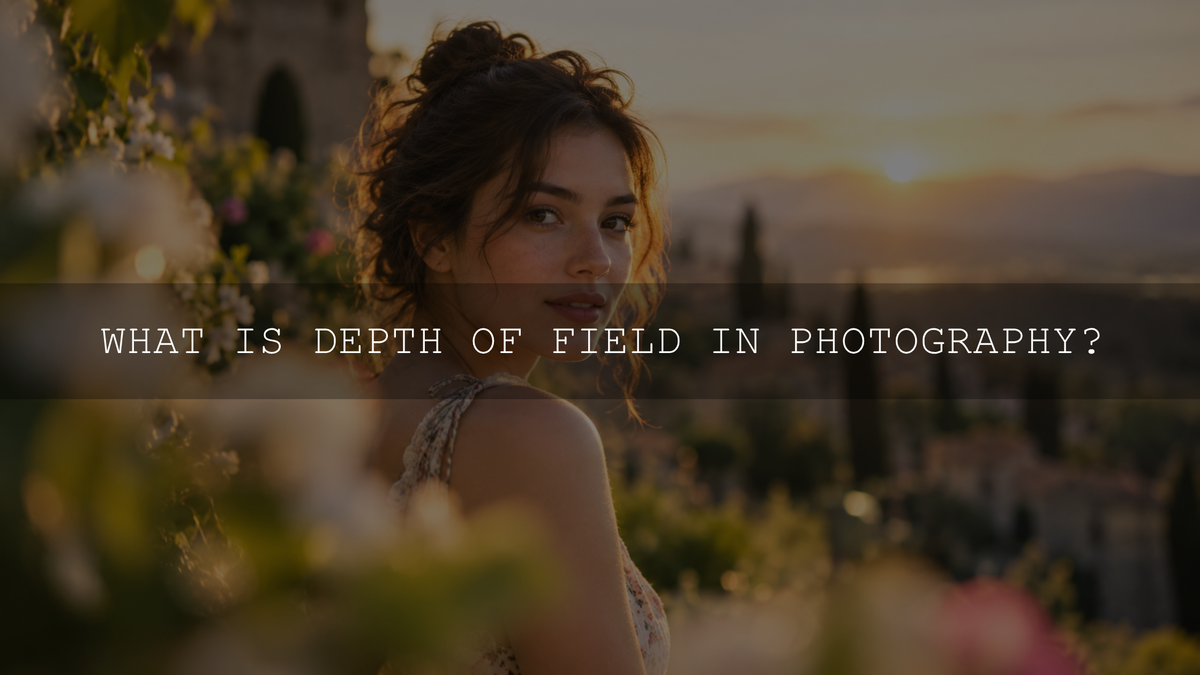
Depth of field is the range of distances in a photograph that appears acceptably sharp around the distance where the lens is focused. The camera focuses most precisely at a particular distance, while an area in front of and behind that distance can still look sharp enough to the viewer.
A shallow depth of field means that acceptable sharpness covers a relatively narrow range. A deep depth of field means that range is much larger.
- Shallow depth of field: A relatively small portion of the scene appears sharp while areas in front of or behind it become increasingly blurred.
- Deep depth of field: A larger range of distances appears acceptably sharp, potentially covering important foreground, middle-ground and background elements.
If aperture terminology still feels confusing, start with the AAAPresets guide to how f-stops and aperture work. A lower f-number represents a wider aperture, while a higher f-number represents a narrower aperture.
What Is Shallow Depth of Field?
Shallow depth of field is useful when you want the viewer’s attention concentrated on one subject or a very small part of the scene. A portrait might have sharply focused eyes while the background becomes soft. A wildlife photograph may isolate an animal from distracting vegetation. A food or product photograph may keep one important detail crisp while other elements gradually fall out of focus.
The goal is not simply to create the maximum possible blur. The important subject still needs enough depth of field to remain acceptably sharp.
How to Create Shallower Depth of Field
Several controls can work together to reduce depth of field:
- Use a wider aperture. Settings such as f/1.8, f/2.8 or f/4 generally provide less depth of field than f/8 or f/11 when the other relevant conditions remain similar.
- Move closer to the subject. Depth of field becomes shallower as focusing distance decreases. This is one reason close-up and macro photography can have extremely limited depth of field.
- Increase the distance between the subject and background. Moving the background farther behind the focused subject can create stronger visual separation even without changing aperture.
- Use focal length deliberately. Longer focal lengths can magnify the background and make blur appear more prominent, but focal length, camera position and framing interact. Do not treat focal length as an independent depth-of-field control.
- Consider camera format when comparing equivalent compositions. Full-frame cameras can make very shallow depth of field easier to achieve than smaller formats when comparing similar framing at the same f-number, but sensor size is not an independent blur control.
For a more detailed format comparison, see full-frame vs APS-C cameras.
When Shallow Depth of Field Works Well
Shallow depth of field is especially useful when visual separation matters. Common examples include:
- Single-person portraits.
- Wedding portraits and detail photographs.
- Wildlife and animal portraits.
- Food photography.
- Product details.
- Flowers and close-up subjects.
- Street photographs where a busy background would otherwise compete with the subject.
Do not assume that the widest aperture on your lens is automatically the best setting. At very shallow depth of field, an eye may be sharp while eyelashes, ears or another important feature fall outside the acceptable focus range. When photographing two people at slightly different distances, one person may also become noticeably softer.
Sometimes moving from f/1.4 to f/2.8 or f/4 produces a stronger photograph because the subject gains enough depth while the background still remains pleasantly soft.
What Is Deep Depth of Field?
Deep depth of field keeps a much larger range of the photograph acceptably sharp. Instead of isolating one small detail, it allows several distances within the composition to contribute clearly to the image.
This is useful in landscape photography when nearby rocks, trees or flowers and distant mountains all matter. It is also useful for architecture, interiors, environmental photographs and groups of people arranged at different distances from the camera.
How to Create Deeper Depth of Field
- Use a narrower aperture. Settings such as f/8 or f/11 often provide substantially more depth than f/1.8 or f/2.8, although the correct setting depends on the scene, lens and focusing distance.
- Place focus deliberately. Focusing at the nearest object is not always the best strategy, and focusing automatically at infinity may leave an important foreground outside the acceptable sharpness range.
- Increase camera-to-subject distance when composition allows. Greater focusing distances generally increase depth of field.
- Use shorter focal lengths when they suit the composition. At the same focusing distance and f-number, a shorter focal length generally provides greater depth of field. In practice, changing focal length often changes framing or camera position too, so choose focal length primarily for the composition and perspective you want.
- Stabilize the camera when necessary. A narrower aperture admits less light at the same shutter speed and ISO. If the required shutter speed becomes too slow to hand-hold safely, a tripod or other stable support can help when subject movement allows it.
For landscapes, the goal is not to choose the highest f-number available. The AAAPresets landscape aperture guide explains why f/8 or f/11 can be useful starting points and when narrower apertures or focus stacking make more sense.
Shallow vs Deep Depth of Field: When Should You Use Each?
The easiest way to decide is to ask what information the photograph needs to communicate.
Use Shallow Depth of Field When One Subject Should Dominate
Imagine photographing a fruit seller inside a crowded market. The background contains shoppers, signs, shelves and other distractions. A relatively wide aperture combined with good subject-to-background distance can keep the seller’s face or hands prominent while allowing the surrounding activity to fall into softer focus.
The photograph still communicates that the subject is inside a busy environment, but the viewer is less likely to be distracted by every individual background element.
Use Deep Depth of Field When Context Is Part of the Story
Now imagine stepping outside the same market into a historic plaza. The foreground paving, architecture, people and distant skyline may all contribute to the story. In that situation, deliberately using greater depth of field can be more effective than isolating one object.
Deep depth of field does not mean every pixel at every distance is perfectly focused. It means the important parts of the composition fall inside a range that appears acceptably sharp at the intended viewing conditions.
Portraits: Do Not Use the Widest Aperture Automatically
Wide apertures are popular for portraits because they can separate a person from the background, but extremely shallow depth of field creates less margin for focusing errors.
If the face is angled toward the camera, one eye may be slightly closer than the other. At very close distances and wide apertures, it is possible for one eye to appear sharp while the other is noticeably softer. Couples and groups create an even larger problem when faces are positioned at different distances.
For multiple people, arrange faces at similar camera distances when possible and use enough aperture depth to cover the group. The AAAPresets guide to aperture for group photos provides practical starting ranges for different arrangements.
Macro Photography Can Have Extremely Shallow Depth
Macro photography is an important exception to the idea that you need a very wide aperture to produce shallow depth of field. At very close focusing distances, depth can become extremely limited even at moderately narrow apertures.
For example, when photographing a small flower, insect or water droplet at high magnification, only a thin portion of the subject may fall inside the acceptable sharpness range. Stopping down can increase that range, but eventually diffraction can reduce fine-detail sharpness across the frame.
When a single exposure cannot provide enough depth, focus stacking can be a better solution. The photographer captures several photographs focused at slightly different distances and combines the sharp regions during post-processing.
Depth of Field, Background Blur and Bokeh Are Not the Same Thing
These terms are closely related but describe different things.
Depth of field describes how much of the scene around the focus distance appears acceptably sharp.
Background blur describes how far out of focus background details appear. Subject-to-background distance has a major effect here. Two portraits photographed with the same aperture can have very different-looking backgrounds if one subject is standing directly against a wall and the other is several metres in front of it.
Bokeh refers to the visual character of out-of-focus areas rather than simply how much blur exists. Lens design, aperture shape, highlights and the structure of the background can all influence how bokeh appears.
This distinction matters because buying a faster lens or selecting f/1.4 does not automatically guarantee an attractive background. Composition and distance remain important.
Does Sensor Size Affect Depth of Field?
Sensor size matters, but comparisons need to be made carefully.
In practical comparisons where photographers maintain similar framing and use the same f-number, full-frame cameras generally make shallower depth of field easier to achieve than APS-C or smaller formats. Achieving equivalent framing often changes the focal length or camera position used, and those changes also affect the result.
That is why it is more accurate to think of sensor format as one part of the complete camera-and-lens system rather than treating sensor size as a standalone background-blur setting.
An APS-C camera can still create strong subject separation by using a suitable focal length, a sufficiently wide aperture, a close enough focusing distance and generous space between the subject and background.
Why f/16 or f/22 Is Not Automatically Better for Deep Focus
Narrowing the aperture generally increases depth of field, but greater depth of field is not the same thing as maximum optical sharpness.
At very small apertures, diffraction becomes increasingly visible. Light spreads as it passes through the small opening, which can reduce the finest detail recorded throughout the image.
This does not make f/16 or f/22 unusable. Sometimes the extra depth of field is more valuable than the small loss of fine detail. The correct decision depends on the scene and final use of the photograph.
If you need extreme near-to-far sharpness and stopping down is causing too much diffraction, focus stacking may provide a better balance.
Do Not Force ISO 100 Just to Get Deep Depth of Field
A narrower aperture lets less light through the lens, so another exposure setting normally has to compensate. If the subject and camera are completely stationary, a slower shutter speed and tripod may be appropriate. If something is moving, however, lowering the shutter speed too far can cause motion blur.
In that situation, increasing ISO can be the better compromise. A photograph with a little more visible noise but sharp subject detail may be more useful than a low-ISO photograph blurred by subject or camera movement.
The AAAPresets guide to how aperture, shutter speed and ISO work together explains how to balance those trade-offs.
Common Depth-of-Field Mistakes
- Assuming f/1.4 automatically creates a better portrait. Very shallow depth can leave important facial features outside the acceptable focus range.
- Assuming f/22 makes the entire photograph sharper. It may increase depth of field while also increasing diffraction softness.
- Focusing on the wrong part of a portrait. When depth is extremely shallow, focus placement becomes critical.
- Ignoring subject-to-background distance. Moving the subject away from the background can improve separation without buying another lens.
- Changing aperture without watching shutter speed. Stopping down can push shutter speed low enough to introduce unwanted motion blur.
- Using ISO 100 at any cost. The lowest ISO is not useful if it forces settings that ruin the photograph.
- Thinking focal length works independently of framing. Changing focal length usually changes camera position or composition as well, so real-world comparisons require context.
- Confusing bokeh with depth of field. Depth of field describes the sharp range, while bokeh describes the appearance of out-of-focus rendering.
Can Lightroom Change Depth of Field After You Take the Photo?
The true optical depth of field is determined when the photograph is captured. Editing cannot restore fine subject detail that was genuinely recorded out of focus.
Post-processing can change contrast, brightness, color and local emphasis. Lightroom's Lens Blur tool can also create AI-assisted blur and bokeh effects using a depth map, but that is a simulated post-processing effect rather than a change to the original optical depth of field.
Presets should therefore be treated as part of the color-editing stage rather than a solution to missed focus. Once focus and depth are correct, color grading can help support the mood you intended.
For portrait editing, the Cinematic & Portrait Lightroom Presets include 8 XMP preset looks and 8 DNG preset looks for Lightroom Desktop, Lightroom Classic, Lightroom Mobile and Adobe Camera Raw. They provide a color-grading starting point after the technical capture is complete. You can also browse the wider portrait Lightroom presets collection. The current AAAPresets offer is Buy 3, Get 9 FREE: add 12 eligible packs to your cart and pay for 3.
Shallow vs Deep Depth of Field: Final Takeaway
Use shallow depth of field when you want a narrow area of sharpness and strong subject separation. Use deep depth of field when several distances within the scene need to remain acceptably sharp.
Do not reduce the decision to aperture alone. Aperture, focusing distance, focal length, framing, subject-to-background distance and camera format all influence the result. Wider apertures and close focusing generally push depth shallower, while narrower apertures and greater focusing distances generally provide more depth.
Most importantly, choose the depth of field that supports the photograph rather than automatically chasing the blurriest background or the highest possible f-number. Once you begin making that decision intentionally, depth of field becomes a storytelling tool instead of just another camera setting.
Written by Asanka — creator of AAAPresets, serving 10,000+ customers.


Leave a comment
This site is protected by hCaptcha and the hCaptcha Privacy Policy and Terms of Service apply.