
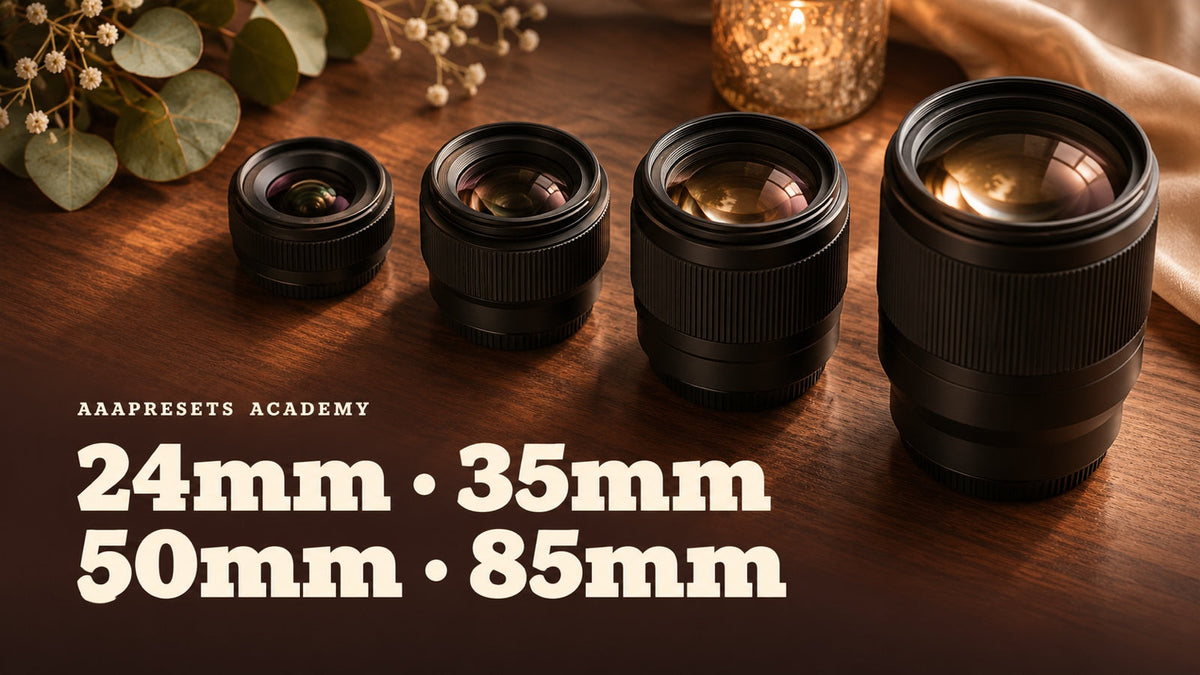
Choosing between a 24mm, 35mm, 50mm and 85mm lens comes down to how much of the scene you want to include, how far you can stand from your subject and the kind of photographs you make. On a full-frame camera, 24mm is a strong choice for expansive scenes and environmental storytelling; 35mm balances people with their surroundings; 50mm offers tighter everyday framing; and 85mm suits portraits where you want a comfortable working distance and less background clutter. None is automatically the best prime lens for everyone.
Before buying one, it helps to understand what actually changes with focal length, what depends on camera position, and how the same lens behaves on a crop-sensor camera.
24mm vs 35mm vs 50mm vs 85mm: A Quick Comparison
- 24mm — wide and immersive: Landscapes, interiors, architecture and environmental portraits. Best when space is limited or the setting is central to the story. Watch for distracting edges and stretched-looking people near the frame boundaries.
- 35mm — context with a clear subject: Street photography, travel, documentary work and everyday moments. It keeps more surroundings visible than 50mm while allowing people to remain prominent.
- 50mm — balanced and selective: Everyday portraits, details, lifestyle scenes and general photography. It excludes more background than 35mm without requiring as much distance as 85mm.
- 85mm — tight and subject-focused: Headshots, individual portraits, fashion details and selective compositions. It can simplify a busy background, but you need more room to frame larger subjects.
These descriptions assume a full-frame camera. Sensor size changes the angle of view, so check the crop-factor section below if you shoot APS-C or Micro Four Thirds.
What Changes When You Switch Focal Lengths?
Field of view changes; perspective depends on camera position
Focal length controls the angle of view: how much of the scene fits inside the frame. At the same camera position, 24mm includes much more of the environment than 85mm. If you crop the wider photograph to match the tighter framing, the underlying perspective remains the same because the camera has not moved.
The familiar wide-angle and telephoto looks often involve a second change: working distance. To keep a person's face the same size in the frame, you normally stand closer with 24mm and farther away with 85mm. That movement changes the apparent size relationship between facial features and between the person and the background. Sony explains these relationships in its guide to focal length and lens perspective.
Distortion and background blur are separate decisions
A close wide-angle portrait can make a nose or foreground hand appear disproportionately large because of perspective. People near the edges of a wide image may also look stretched by the projection. Separately, a lens can have optical barrel or pincushion distortion, which depends on its design and corrections. A 50mm lens is not automatically distortion-free.
Background blur depends on more than focal length. Aperture, focus distance and the distance from your subject to the background all matter. An 85mm portrait often looks cleaner because the narrower view includes less background and magnifies the blur that is there. For a deeper explanation, see how focal length changes depth of field.
24mm: Wide Scenes and Environmental Storytelling
A 24mm prime works well when the environment is part of the subject. Think of a traveler surrounded by a busy market, a small café interior or a dramatic foreground leading into a landscape. You can get close to an important element while retaining enough space around it to establish a sense of place.
The challenge is composition. The wider frame can collect unwanted objects, and moving very close to a face can exaggerate its nearest features. For people, leave breathing room near the frame edges and consider stepping back when natural facial proportions are important. A 24mm can make excellent portraits, but the photographer must use distance and framing deliberately.
35mm: Street, Travel and Documentary Photography
For many photographers who want one lens for everyday storytelling, 35mm is a practical starting point. It shows a person alongside the street, room or landscape that gives the moment meaning. Compared with 24mm, it is easier to exclude irrelevant surroundings; compared with 50mm, it keeps more context without stepping as far back.
Its trade-off is that you still need to work fairly close for tight portraits, which may not suit every subject or situation. In a crowded space, a busy background can compete with the person. Change your angle, wait for a cleaner moment or move your subject relative to the background instead of assuming a wider aperture will solve everything.
50mm: Balanced Everyday Framing
A 50mm prime is useful for portraits, food, lifestyle details and quieter documentary frames. Its narrower view makes it easier to concentrate attention on a person or object without removing all sense of place. A relatively fast 50mm lens can also offer useful low-light and subject-separation options, although maximum aperture, weight and price vary by model.
The often-repeated claim that 50mm exactly matches human vision is too simple. Human vision does not have one fixed camera-equivalent field of view, and a 50mm lens does not eliminate perspective or optical distortion. Think of 50mm as a comfortable middle ground rather than a scientifically perfect representation of what your eyes see.
85mm: Portraits and Cleaner Backgrounds
An 85mm lens is a popular portrait focal length because you can fill the frame with a person's face or upper body without standing extremely close. That working distance often gives facial features a pleasing appearance, while the narrow view helps remove distractions. At a suitable aperture and subject-to-background distance, it can produce strong background separation.
The limitation is physical space. In a small bedroom or crowded café, you may struggle to fit a full-body portrait into the frame. But 85mm is not limited to headshots: it can also isolate architectural details, patterns and layers in landscapes. Nikon's focal-length guide explains how wider and longer lenses change framing and magnification.
Which Prime Lens Should You Buy First?
- Choose 24mm when you mainly photograph interiors, wide landscapes or people within expansive locations, and you enjoy composing with the foreground.
- Choose 35mm when your priority is travel, street photography, family life or documentary storytelling with environmental context.
- Choose 50mm when you want a flexible everyday prime with tighter framing for portraits and details, without specializing in headshots.
- Choose 85mm when individual portraits and subject isolation are your main goals, and you usually have enough room to work.
If you are torn between 35mm and 50mm, ask a simple question: do you regularly wish your photographs included more of the environment or less of it? If you already favor compositions that show where a person is, start with 35mm. If you instinctively crop away distractions, 50mm may suit you better.
Remember Crop Factor: These Are Full-Frame Comparisons
A lens keeps its stated focal length on any compatible camera, but a smaller sensor records a narrower portion of the image. On a typical 1.5× APS-C camera, 24mm gives approximately the full-frame field of view of 36mm; 35mm looks like 52.5mm; 50mm like 75mm; and 85mm like 127.5mm. Canon APS-C bodies commonly use a slightly larger 1.6× crop factor.
That means a 35mm prime on APS-C may feel more like a standard everyday lens than a moderately wide documentary lens. Micro Four Thirds cameras use approximately a 2× crop factor, so a 25mm lens gives roughly the same angle of view as a 50mm lens on full frame. The official Micro Four Thirds FAQ explains this equivalence. If your camera format is uncertain, see our guide to full frame versus APS-C before choosing a focal length.
Try This Test Before Spending Money on a Prime
- Use the zoom lens you already own. Set it to 24mm, 35mm and 50mm in turn. If it reaches 85mm, test that too. A 24–70mm zoom can preview the first three but cannot reproduce 85mm exactly.
- Make a same-position comparison. Photograph one stationary scene without moving your feet. Compare how much of the surroundings fit into each frame. This isolates the framing change.
- Make a same-framing comparison. Photograph a person or object at each focal length, moving forward or backward to keep it approximately the same size. Look at the background and proportions. This reveals the practical effect of changing working distance.
- Repeat in your real shooting conditions. Try an indoor room, a street scene and a portrait. Pay attention to how often you run out of space or have to crop heavily.
- Review your photo metadata. The focal lengths you repeatedly use on your zoom can suggest a good prime, but consider which scenes you could not photograph comfortably as well.
Before buying, compare actual lens models for aperture, autofocus, close-focus distance, size, weight, mount compatibility and price. A prime at your favorite focal length is only useful if you enjoy carrying and using it.
What About Editing Photos Shot with Different Lenses?
Focal length establishes the composition in camera; editing should support that decision rather than try to replace it. If a series mixes wide documentary images with tight portraits, consistent exposure, white balance and color treatment can help it feel coherent. Correct lens-profile or geometric distortion when needed, but do not expect a preset to undo the viewpoint of a very close wide-angle portrait.
For photographers editing people and lifestyle photos, Bright Natural Lightroom Presets offers eight looks supplied in XMP and DNG formats for compatible Lightroom workflows. Treat a preset as a color and tone starting point, and refine exposure and white balance for each image. You can also browse the Portrait Lightroom Presets collection if portraits are your main subject.
The Bottom Line
Choose 24mm to emphasize the place, 35mm to balance people and context, 50mm to simplify everyday compositions, or 85mm to concentrate on your subject. The best way to make the decision is to compare them at real shooting distances, on your own camera format, before investing in a prime.
Written by Asanka Dilshan, founder of AAAPresets.


Leave a comment
This site is protected by hCaptcha and the hCaptcha Privacy Policy and Terms of Service apply.