
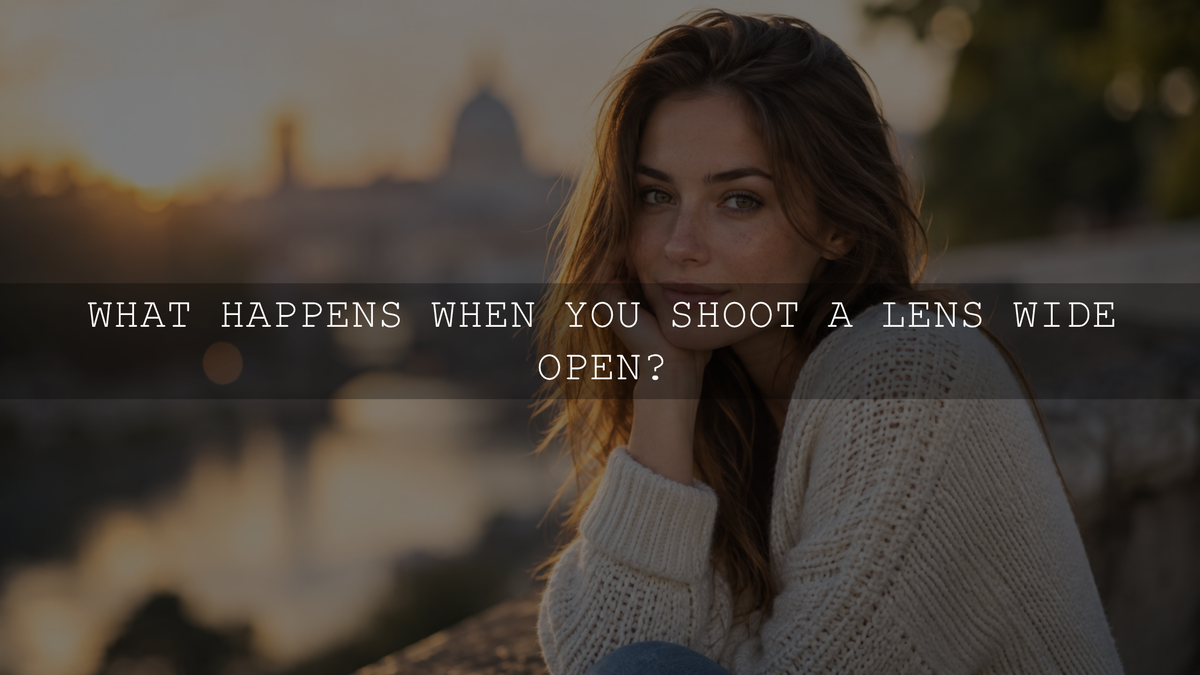
Shooting wide open means setting your lens to its widest available aperture, which is represented by its lowest available f-number. On a 50mm f/1.8 lens, for example, shooting at f/1.8 is wide open. On a 24-70mm f/2.8 lens, f/2.8 is wide open.
This setting allows the maximum amount of light available through that lens at the selected focal length and usually produces the shallowest depth of field that particular lens and shooting setup can provide. That can be useful for portraits, low-light photography, street scenes and other situations where you want subject separation or more light.
Wide open is not automatically the best aperture, though. Focus becomes less forgiving, some lenses behave differently at maximum aperture, and you may simply need more depth of field for the photograph you are making. Understanding those trade-offs is more useful than keeping the lens at its lowest f-number all the time.
What Does Shooting Wide Open Actually Mean?
Aperture is the adjustable opening inside a camera lens. Your camera displays its size using f-numbers such as f/1.4, f/1.8, f/2.8, f/4 and f/8.
The numbering initially seems backward: a lower f-number represents a wider effective aperture, while a higher f-number represents a narrower aperture. Therefore, f/1.8 is wider than f/4. For a deeper explanation of the numbering, see our guide to what an f-stop means in photography.
Every lens has a maximum aperture. This is the widest aperture the lens can provide and normally the lowest f-number available. Using that maximum aperture is what photographers mean when they say they are shooting wide open.
Wide open does not always mean f/1.4 or f/1.8. A lens whose maximum aperture is f/4 is being used wide open when it is set to f/4. Similarly, an f/2.8 zoom is wide open at f/2.8.
What About Variable-Aperture Zoom Lenses?
Some zoom lenses have a maximum aperture that changes as you zoom. A lens marked 18-55mm f/3.5-5.6, for example, may allow approximately f/3.5 at the wide end but only approximately f/5.6 near the telephoto end.
In that situation, the meaning of wide open changes with focal length. At one position the maximum aperture might be f/3.5, while after zooming in it might become f/5.6. Both settings can be wide open because each represents the widest aperture available at that particular focal length.
What Changes When You Shoot Wide Open?
Opening a lens to its maximum aperture primarily changes two things that matter creatively: the amount of light passing through the lens and the available depth of field.
More Light Passes Through the Lens
A wider aperture allows more light through than a narrower setting on the same lens under equivalent conditions.
For example, opening from f/4 to f/2.8 is approximately a one-stop change. That means roughly twice as much light can pass through the aperture. You could potentially exchange that extra light for a faster shutter speed, a lower ISO, or a combination of the two.
This is one reason lenses with relatively wide maximum apertures are often called fast lenses.
The important point is that opening the aperture does not guarantee that you can always use a low ISO. If the scene is extremely dark or your subject requires a very fast shutter speed, you may still need to increase ISO.
Depth of Field Becomes Shallower
A relatively wide aperture generally reduces depth of field. Depth of field is the range of distances around your focus point that appears acceptably sharp in the finished photograph.
This can help separate a subject from its surroundings. A portrait photographed at a wide aperture may show sharp eyes and facial detail while the background becomes much softer and less distracting.
However, aperture does not determine background blur by itself. Focal length, camera-to-subject distance and the distance between the subject and background also influence the result.
For example, photographing someone at f/2.8 while they stand directly against a wall may leave that wall relatively recognizable. Move the person farther away from the wall and the background can become considerably softer without changing the aperture.
Background Blur and Bokeh Are Not Exactly the Same Thing
The words are often used interchangeably, but they describe slightly different ideas.
Background blur describes how out of focus the background appears. Bokeh usually refers to the visual character of those out-of-focus areas, including how highlights, textures and transitions are rendered.
A wider aperture can increase the amount of defocus, but it does not automatically guarantee attractive bokeh. Lens design, the background itself, focal length, distance and aperture shape can all influence how those areas look.
When Is Shooting Wide Open Useful?
Single-Person Portraits
Wide-open apertures are popular for portraits because shallow depth of field can reduce background distractions and draw attention toward the subject.
That does not mean every portrait should be photographed at the lens's maximum aperture. Close portraits can have extremely limited focus depth, especially with longer focal lengths or very short camera-to-subject distances.
Low-Light Photography
Opening the aperture can be valuable indoors, around dusk, at night or in other low-light situations because it gives you more light to work with.
The additional light may let you maintain a faster shutter speed for a moving subject instead of allowing unwanted motion blur. Alternatively, you may be able to use a lower ISO when the shutter speed is already sufficient.
The correct trade-off depends on the photograph. Do not sacrifice the depth of field you actually need simply to keep ISO as low as possible.
For practical low-light starting points, see our guide to choosing an aperture in low light.
Street and Event Photography
A wide aperture can help when photographing people in available light, particularly when subject movement requires a reasonably fast shutter speed.
At the same time, very shallow focus can make unpredictable movement harder to photograph. If people are frequently moving toward or away from the camera, stopping down slightly may provide a more useful focus margin.
Subject Isolation
Wide-open shooting can also work for pets, details, food, flowers and other subjects where you intentionally want one area to command attention while the rest of the scene becomes softer.
The effect does not require an f/1.2 or f/1.4 lens. Even an f/2.8, f/4 or slower lens can create strong separation when focal length and distances work in your favor.
Why Can Wide-Open Photos Look Soft?
A photograph that looks soft at maximum aperture does not necessarily mean anything is wrong with the camera or lens. Several different problems can produce a similar result.
The Depth of Field May Be Too Shallow
At close distances, a wide aperture can leave only a limited part of the subject within the acceptable focus range.
Imagine photographing a face turned slightly away from the camera. If you focus precisely on the nearest eye, the farther eye may appear softer simply because it falls outside the available depth of field.
That is different from autofocus failure. The camera may have focused exactly where you asked it to.
The Subject May Have Moved
With shallow depth of field, small changes in subject distance can become noticeable. A person leaning forward or backward after focus is acquired may move away from the original focus plane.
Modern subject tracking and eye-detection autofocus can help when your camera provides those features, but sufficient depth of field is still important.
Lens Performance Can Change at Maximum Aperture
Optical performance is not identical at every aperture. Depending on the particular lens, maximum aperture may show more vignetting, color fringing, reduced corner performance or other optical characteristics than a slightly narrower setting.
This does not mean wide open is bad. Modern lenses can perform very strongly at maximum aperture, and the additional light or shallow depth of field may be considerably more important than a small technical difference in optical performance.
There is also no universal rule that every lens becomes sharpest at f/4, f/5.6 or f/8. Lens design, focal length and focusing distance all matter.
When Should You Stop the Lens Down?
Maximum aperture is simply one creative option. Use a narrower aperture whenever the photograph needs more depth of field or when the widest setting is creating unnecessary difficulty.
Consider stopping down when:
- You need both eyes or more of a close-up face to appear acceptably sharp.
- You are photographing a couple whose faces are different distances from the camera.
- You are photographing a group with several rows of people.
- Your subject is moving toward or away from you and the focus margin is too small.
- You need more foreground-to-background detail.
- You prefer the rendering or optical performance of a slightly narrower aperture.
Even moving from f/1.4 to f/2, or from f/1.8 to f/2.8, can provide additional depth-of-field margin while still producing noticeable subject separation.
How to Shoot Wide Open Reliably
- Choose the widest available aperture. In Aperture Priority or Manual mode, select the lowest f-number currently available for your lens and focal length.
- Place focus deliberately. For portraits, the eye closest to the camera is commonly an important focus target. Use eye detection or subject tracking when your camera offers a suitable mode.
- Watch your shutter speed. A wide aperture gives you more light, but you still need enough shutter speed for subject movement and camera movement.
- Check the background distance. Moving your subject farther from the background can produce stronger separation without requiring an even faster lens.
- Consider your distance from the subject. Moving closer generally makes depth of field shallower, so extremely close compositions require more careful focus.
- Review important photographs closely. Magnify the area that must be sharp instead of judging focus only from the full image on the rear screen.
- Stop down when necessary. If the important parts of the subject are falling outside the focus range, a slightly narrower aperture may produce a better photograph.
What If Wide Open Is Too Bright Outdoors?
Maximum aperture can sometimes create the opposite problem in strong daylight: more light is entering the camera than you need.
Usually you can compensate with a faster shutter speed and a low ISO. If you are already at the camera's lowest practical ISO and fastest available shutter speed but still want the shallow depth of field of maximum aperture, a neutral-density filter can reduce the incoming light without requiring you to close the aperture.
Stopping the lens down is also perfectly reasonable when extreme background blur is not essential.
A Simple Wide-Open Photography Exercise
The easiest way to understand maximum aperture is to compare it yourself.
- Choose a stationary subject with a reasonably distant background.
- Keep the camera position and focal length consistent.
- Focus on exactly the same part of the subject for every photograph.
- Take the first photograph at your lens's maximum aperture.
- Repeat at several narrower apertures, such as f/2.8, f/4 and f/5.6 where your lens permits.
- Adjust shutter speed or ISO as necessary so the photographs remain reasonably similar in brightness.
- Compare the subject, foreground, background and image corners at a larger viewing size.
Pay attention to more than background blur. Look at how much of the subject remains sharp, how easy focusing becomes and how the lens renders detail at each aperture.
What Editing Can and Cannot Fix
Post-processing can refine a wide-open photograph, but it cannot replace correct capture technique.
Editing can adjust exposure, contrast, color, white balance and local emphasis. Lens corrections can also reduce some visible vignetting, distortion or color fringing when suitable correction information is available.
What editing cannot reliably restore is a subject that was genuinely outside the focus plane. If the eye is out of focus because the depth of field was too shallow, getting the aperture and focus right during capture remains the better solution.
This is also worth remembering when using Lightroom presets: a preset can shape the color and tone of an image, but the optical depth of field and original focus placement were determined when the photograph was captured.
Should You Always Shoot Wide Open?
No. Shoot wide open when the additional light, shallow depth of field or visual separation helps the photograph you want to create.
Stop down when you need more of the subject in focus, greater focus tolerance or a different visual result. Maximum aperture is not a quality setting and a smaller f-number does not automatically produce a better or more professional-looking photograph.
The most useful approach is to choose aperture according to the image rather than according to the maximum specification printed on the lens.
Once you understand that principle, shooting wide open becomes much more than a shortcut to blurry backgrounds. It becomes another deliberate way to balance light, depth of field, focus and composition.
Written by Asanka — creator of AAAPresets, serving more than 10,000 customers.
```

Leave a comment
This site is protected by hCaptcha and the hCaptcha Privacy Policy and Terms of Service apply.